
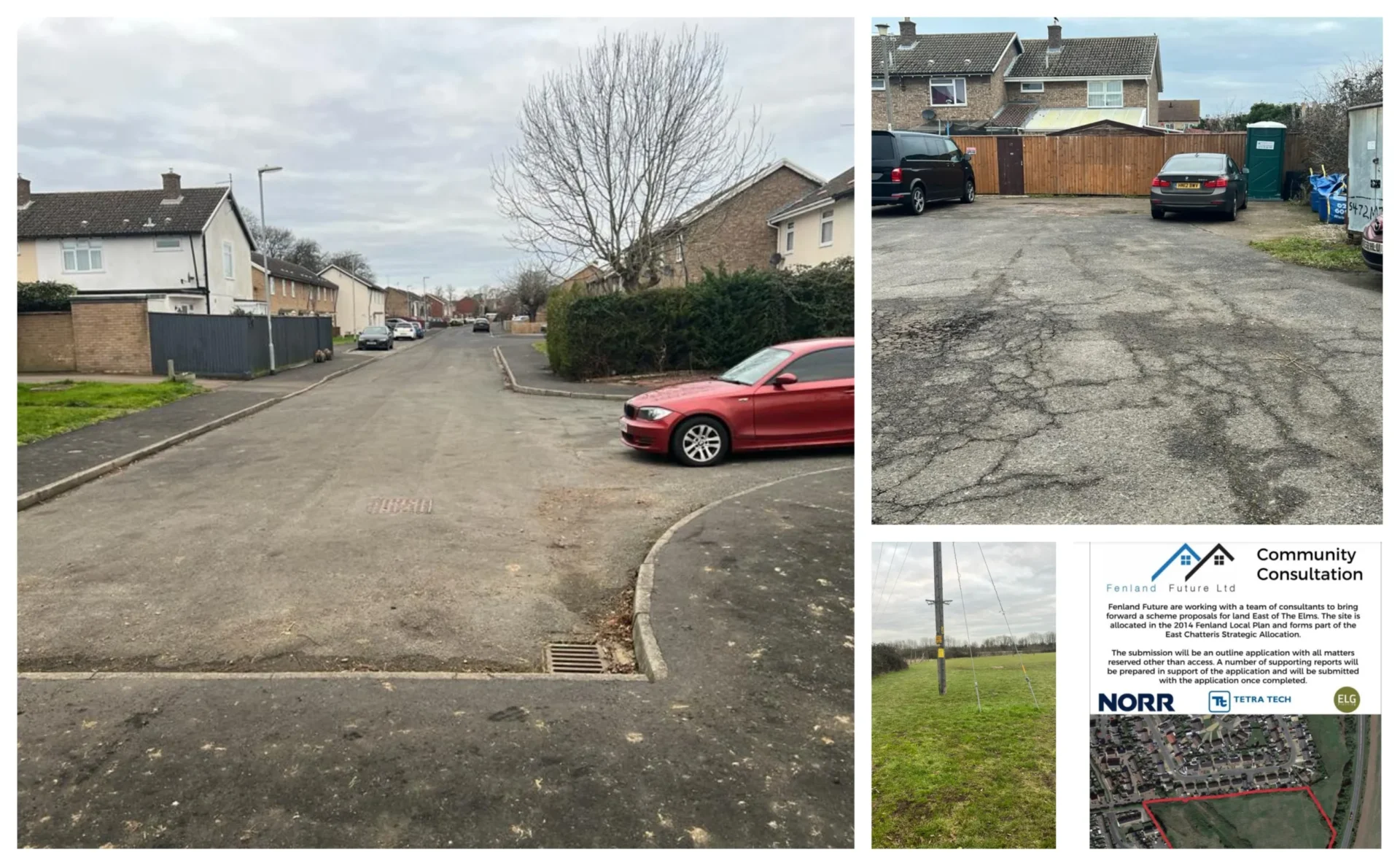
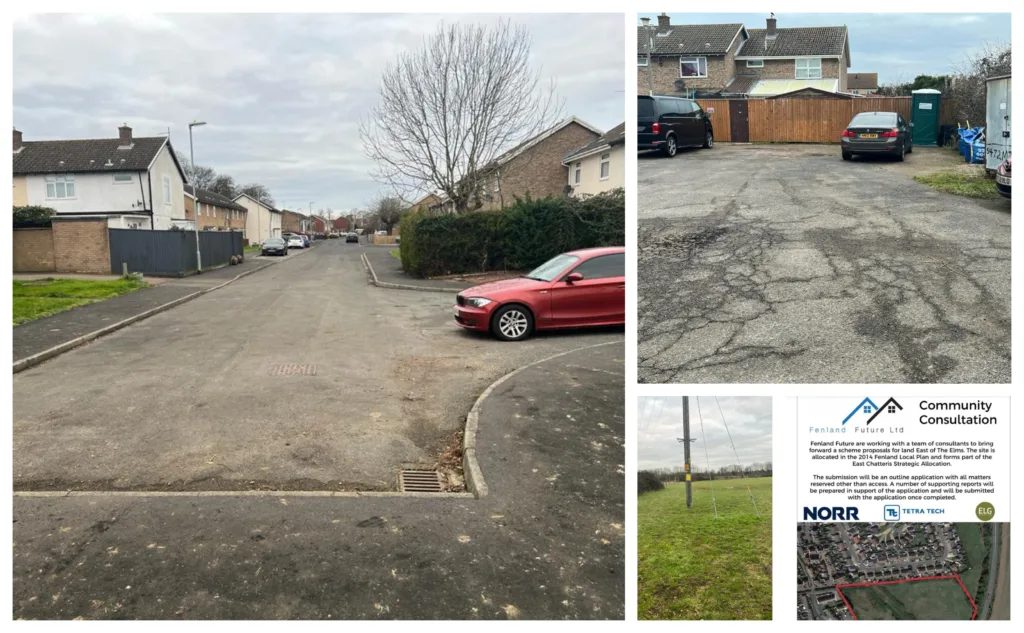
Anger is mounting in Chatteris as Fenland Futures Ltd (FFL), a company wholly owned by Fenland District Council, moves forward with plans for a residential development that may no longer include the affordable homes originally promised.
The scheme, which proposes up to 54 houses on land east of The Elms, has drawn fierce criticism from Chatteris Town Council and local residents after a financial viability report suggested the development cannot sustain any social housing.
FFL’s website paints an optimistic picture. The company promotes a development “to provide a range of homes for sale and affordable homes for rent and shared ownership,” including two, three, and four-bedroom houses, alongside much-needed two-bedroom bungalows.
Partnered with Lovell Partnership as its development management company, FFL expects to start construction in spring 2026, with the first homes occupied by winter of the same year, pending a Reserved Matters planning approval in autumn 2025.
However, the picture on the ground in Chatteris is far less reassuring. A Financial Viability Assessment (FVA), prepared by Carter Jonas on behalf of Lovell Partnerships Ltd, concludes that the site is not financially viable for either the 20% affordable housing specified in the planning permission or even zero affordable homes.

80 homes at Chatteris a major test of Fenland Council’s own housing firm
The report, issued in July 2025, states that “negative residual land values mean the scheme cannot support the required affordable housing contributions or additional financial obligations.”
In short, even the social homes that were the only community benefit appear to be vanishing.
The FVA has sparked fury among local councillors.
Chatteris Town Council, responding to a recent variation of the planning conditions for the site, issued a formal recommendation of refusal. In their November 2025 statement, the council noted:
“There are no Section 106 agreements which will benefit the town, despite the fact that the land was sold by FDC for a profit. The town will gain nothing from this development.
“Affordable housing, which is badly needed for the young people of the town, was to be the only benefit for the community and the proposal is now to remove that element.
“The Town Council continues to dispute the viability report and notes that it appears that FDC keeps on getting viability reports until it gets the answer it wants.
“The council believes this FDC application should be determined by another authority, such as the county council, as there is clearly a conflict of interest.”
A local Fenland ward councillor echoed these concerns earlier in August 2025, highlighting the inconsistency between the original approval and the current proposal:
In an email to Fenland Council, the councillor wrote: “It is not immediately clear what the proposed variation to the southern access entails. Given that the proposed development is not universally popular, the desire to remove the provision of affordable homes has certainly caused consternation amongst the townspeople and members of Chatteris Town Council.
“Why does the developer suddenly feel that they can no longer provide the 20% affordable housing when in their original application, and as mirrored in the planning decision notice, they were happy to include these as part of the development?”
The councillor also noted that Chatteris commands higher house prices than other parts of Fenland, raising questions about the FVA’s assumptions:
The councillor added: “As far as this particular case is concerned, this is a kick in the teeth for local people seeking to get onto the property ladder and would welcome the opportunity to live near their place of work, their families, or the schools their children attend.”
The origins of the dispute trace back to the original planning application, submitted in 2022.
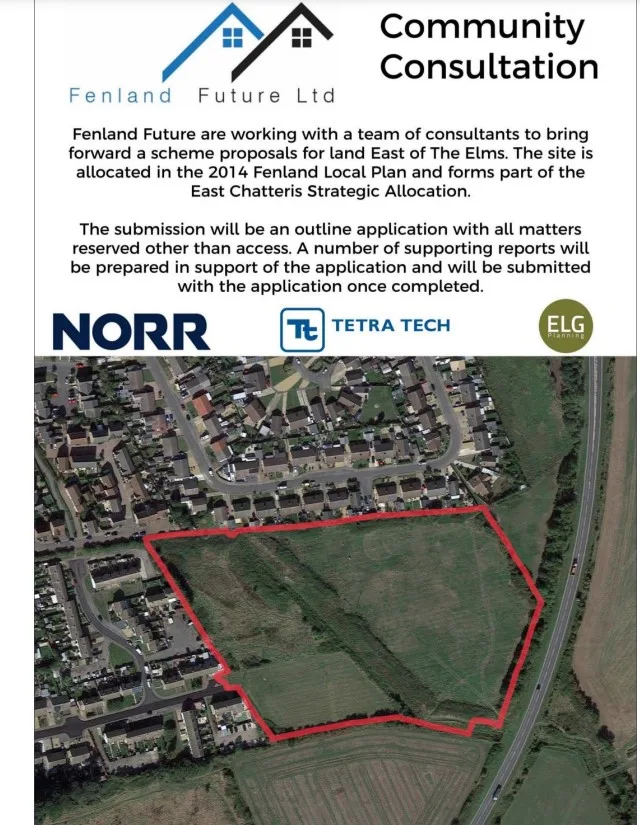
FFL’s outline proposal for up to 80 dwellings on the 3.59-hectare site had already included 20% affordable housing, alongside £2,000 per dwelling in developer contributions.
The planning committee at Fenland District Council approved the scheme in March 2023, acknowledging concerns over access, flooding, and community impact, but ultimately concluding the development was policy compliant.
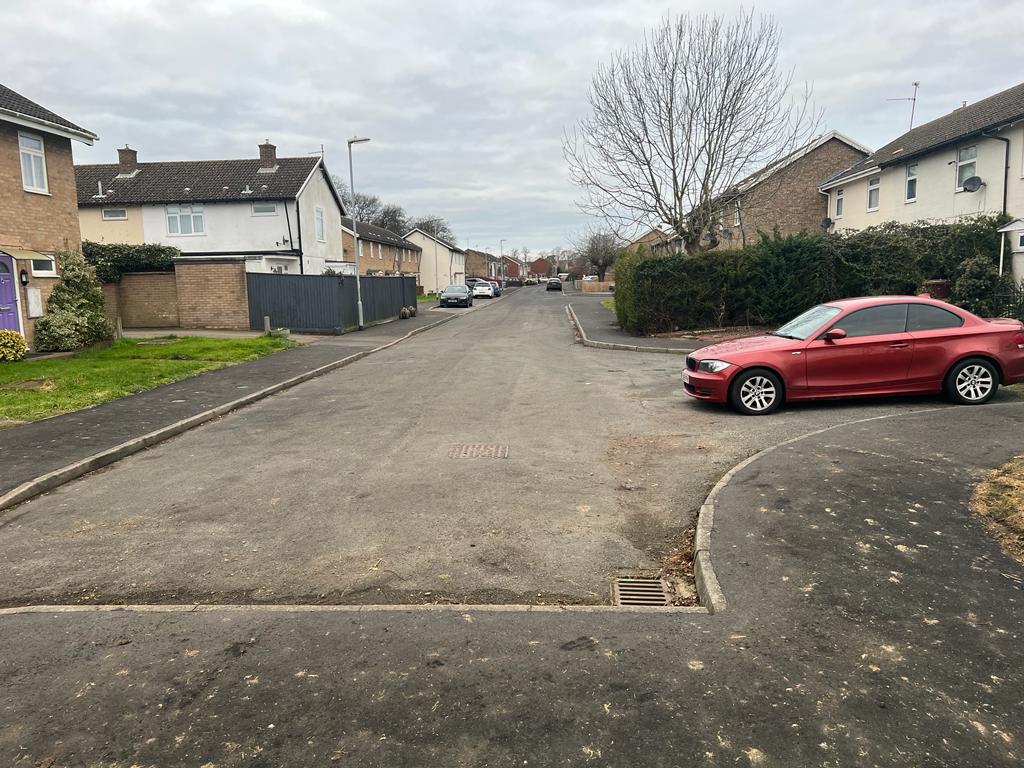
At the planning committee meeting on 8th March 2023, councillors debated key issues, particularly the access via The Elms. Several councillors admitted the route was “dreadful,” but the Local Highway Authority raised no formal objection, and more technically viable alternatives, such as access from the A142, were deemed prohibitively expensive.
Ward councillor Ian Benney, at the time a Cabinet member at Fenland Council spoke in support of the scheme, emphasising the longstanding lack of major housing developments in Chatteris and highlighting the need for high-quality family homes, including the 20% affordable housing component.
Objectors, however, raised significant concerns.
Local resident Alan Melton, a former councillor and former leader of Fenland District Council, warned that flooding in The Elms could be exacerbated by the development and criticised piecemeal development as contrary to holistic planning.
The planning committee ultimately balanced these concerns against policy compliance and technical assurances, approving the scheme with conditions on drainage, land levels, and construction management.
Yet the promise of affordable homes now appears under threat.
Carter Jonas’ viability report uses a methodology aligned with the National Planning Policy Framework (NPPF) and Planning Practice Guidance, including the “existing use value plus” (EUV+) approach for land valuation.
Despite this, the findings indicate that, under current market conditions, the development cannot sustain affordable housing or additional financial obligations.

The report also notes broader policy implications:
- Policy requirements for affordable housing may be unachievable on this site under present market conditions.
- If sales values or construction costs do not improve, policy flexibility may be required to avoid stalling development.
- Local authorities must balance the goal of delivering affordable housing with the risk that overly stringent requirements could render sites undeliverable.
For Chatteris residents, these “policy flexibilities” offer cold comfort.
Affordable homes were the only element of the scheme directly benefiting the local community, particularly young families seeking their first home. Without them, the town risks losing the sole tangible advantage of the development while FFL still profits from the land sale.
The controversy also raises uncomfortable questions about Fenland District Council’s dual role as landowner and planning authority.
Chatteris Town Council explicitly highlighted a potential conflict of interest, suggesting that the application should be determined by an external authority, such as the county council.
Critics note a pattern in Fenland, where developers initially promise generous Section 106 contributions only to withdraw them later, often citing viability.
Residents and councillors alike feel misled. The town council’s statement notes that “it appears that FDC keeps on getting viability reports until it gets the answer it wants.”
Similarly, the ward councillor remarked on the sudden reversal regarding affordable housing, pointing out that the original application had no such financial obstacles.
Chatteris is not alone in facing such conflicts.
Across the country, local authorities that also act as developers are increasingly scrutinized for potential conflicts of interest, particularly when promised community benefits fail to materialize.
In this case, the tension is heightened by the fact that the development land was sold by FDC for profit, yet the town stands to gain little from the scheme if affordable housing is removed.
The situation has left residents questioning the credibility of both the developer and the planning process.
Once heralded as a solution to Chatteris’ housing shortage, the FFL development now risks being seen as a council-backed exercise in maximising profit, rather than delivering meaningful community benefits.
Town councillors argue that young people in Chatteris, who were counting on affordable homes, are being “hoodwinked” by the process.
For the local council, the stakes are clear: accept the viability report and lose the affordable housing provision or challenge the findings and risk delaying the development.
Chatteris Town Council’s position is firm: the current proposal should be refused, and the application should be reconsidered by an impartial authority.
Meanwhile, the planning committee’s earlier approval looms large over current debates.
In March 2023, councillors were aware of access constraints and the challenges of council-owned land development but approved the scheme based on policy compliance and technical assurances.
Today, the same site is being offered under significantly altered conditions, with the cornerstone of community benefit—the 20% affordable housing—threatened.
This disconnect between approval and delivery has inflamed public sentiment. For many, the key question is whether Fenland District Council’s residents are being misled, or worse, sidelined in decisions that directly affect the town’s housing future.
Local voices are unequivocal. In public forums and council meetings, there is widespread frustration at the perception that policy compliance and financial viability are being interpreted in a way that undermines the original promises to the community.
One councillor described the development as “a kick in the teeth for local people seeking to get onto the property ladder,” while the town council stresses that the only intended benefit—the affordable housing—has now disappeared.
The debate is set to continue as FFL pursues Reserved Matters planning approval. With construction scheduled to begin in spring 2026, residents are anxious that without intervention, the scheme will proceed without delivering the social housing that was the original selling point.
Questions over council accountability, transparency, and the interpretation of viability reports remain unresolved.
For Chatteris, the FFL development highlights the tension between economic realities and community expectations. While local authorities must navigate market conditions and policy frameworks, the removal of affordable housing from a scheme on council-owned land raises serious ethical and political concerns. Residents are left asking whether they have been promised homes but will end up with little more than market-rate housing and a council profit.
For the town, the FFL scheme has become a test case of trust in local government. The council’s dual role as landowner and planning authority, the repeated use of viability reports, and the removal of affordable housing are combining to create a perfect storm of public dissatisfaction.
With construction deadlines approaching, Chatteris residents, and their representatives, will be watching closely to ensure that the promises made in March 2023 are not quietly eroded in 2025.
Whether Fenland District Council will reconsider or continue to push the scheme as currently proposed remains to be seen. What is certain is that the debate has already reshaped perceptions of local planning, accountability, and the value of council-owned land in Chatteris.