
Evidence has emerged that the crisis now engulfing the Kings Dyke bridge at Whittlesey was predicted years before construction was completed. Internal reports from 2019, seen by CambsNews, warned that the scheme risked becoming an “undeliverable project on the current brief”, citing incomplete design work, extreme ground instability and serious reputational danger for those backing it.
More than 18 months after emergency restrictions reduced the Ralph Butcher Causeway to a single lane, the warnings read less like hindsight and more like a roadmap to failure.
The documents show that, well before the bridge opened, insiders feared spiralling costs, unresolved technical flaws beneath the crossing, and contractor performance problems that could derail the project entirely.
The leaked papers also reveal that senior figures were already discussing a possible break with the original contractor Kier, alongside concerns about litigation, funding gaps and political fallout.
‘Parting company with Kier’

By mid-2019, internal confidence in the project’s delivery had visibly weakened.
A briefing paper, marked CONFIDENTIAL – KINGS DYKE, set out a series of escalating concerns under the heading “parting company with Kier.” The document records worries about potential litigation, unresolved funding arrangements, and what it described as the “reputational risk”.
At the centre of those concerns was Kier, then the design-and-build contractor. The briefing questioned whether the design process itself was sufficiently robust, asking whether “the design work [was] being done right” and whether the scheme had become structurally compromised before construction had meaningfully progressed.
A formal update dated 7 June 2019 reached a blunt assessment: “The target cost provided by Kier is not contractible.”
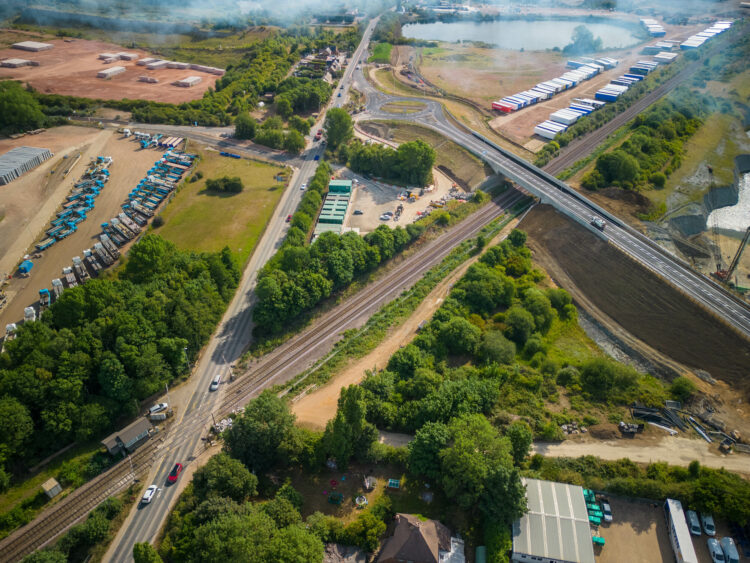
The reasons given point to systemic uncertainty rather than isolated issues. The update states that the design was incomplete and that the proposed engineering solution to overcome Star Pit — the former clay extraction site beneath the crossing — was “not currently considered deliverable”. As a result, both cost and programme were described as subject to further change.
Picture by Terry Harris.
While the report noted that elements of the scheme outside Star Pit were technically buildable, it added a significant caveat: the overall solution “may not be the optimum”.
Costs, governance and funding gaps
Alongside technical uncertainty, internal documents charted a rapid escalation in projected costs.
The original estimate of £16.9m in 2017 had increased to £29.9m by 2018. By spring 2019, officials were warning internally that the total cost could reach £39.5m, with an explicit acknowledgement that this figure could rise further “with claims during construction”.
At the same time, governance arrangements remained unresolved.
Although the Cambridgeshire and Peterborough Combined Authority had agreed in principle to co-fund the scheme in 2018, the leaked notes repeatedly highlight a critical omission: there was no signed funding agreement.
One internal note records that despite providing funding, the authority had “no role with admin of contract”. Another highlights reputational exposure, stating bluntly: “reputational risk is to M.”
The documents do not expand on the reference, but they indicate awareness at the time that political accountability could attach to the scheme even where formal control was limited.
Ground risk and independent warnings
Independent scrutiny reinforced concerns already circulating internally.
A cost review by consultants WYG, commissioned in 2019, focused particular attention on ground conditions and stabilisation works. The review highlighted unusually high allowances for ground treatment and raised questions about whether the procurement approach was delivering value for money.
In its assessment, WYG stated: “We do not believe that the uplifts added to subcontractors reflect that of a competitive tender.”
The review suggested that Kier’s approach could be interpreted in one of two ways: either as an overly cautious commercial position, or as an indication that the technical challenge was so significant that few specialists were willing or able to undertake the work.
While WYG identified potential savings across areas including earthworks, drainage and paving, it also acknowledged wider market pressures, noting competition for fill materials from major schemes such as the A14 Huntingdon improvement works.
The review confirms that ground instability — now central to the ongoing remediation — was neither unforeseen nor marginal, but a dominant risk explicitly identified before construction progressed.
Replacement of Kier and opening of the bridge
Kier was later replaced as contractor; on May 22, 2020, Jones Bros Civil Engineering UK of Ruthin, Wales, announced it had secured the £32m contract for a new road and bridge over the Ely to Peterborough railway line.
The company said it had “won the re-tendered contract after scoring highest on quality and price”. The crossing opened in July 2022.

Behind the scenes, as the leaked documents show, the Kings Dyke bridge was the subject of fervent discussion because of unexpectedly weak ground at a key point.
Instead of redesigning the whole bridge, the team found creative engineering solutions—like building a special kind of viaduct and strengthening the ground—to make the original plan work.
It seems from the documents seen by CambsNews that the county council opted for this approach – what is termed a Construction Management (CM) method “having regard to time, certainty, risk and cost.”
Officials explained that although CM was not a common form of procurement for civil engineering projects, “there is by the nature of a CM contract a greater risk borne by the client that will require a strong client function with the appropriate skills and capacity to managed the increased client role”.
They added: “The client also needs the skills and capacity to manage the increased client role. Design by carried out by the construction manager, thereby alleviating the client of the design risk. There is the opportunity to reduce the time of the overall project by overlapping of activities and features of a CM approach”.
These choices helped keep the project on track and avoided extra delays and expenses.
In their tender notice issued on August 27, 2019, the county council confirmed their approach.
It announced they stated that “the scheme was previously awarded as a 2 stage design and build contract, for which a detailed design was completed.
“Cost estimates increased over time and so the authority is now seeking improved outcomes from the market.
“The provider will be required to take responsibility for the existing detailed design but may seek approval from the authority as to where it may be improved. The authority therefore welcomes value engineering exercises from the provider but notes that existing planning consent, site and technical constraints must be all upheld in any proposals which may come forward. Non-material amendments may be considered”.
Changing the bridge design would have meant going back to the drawing board, which would have taken a lot of time and money, a possibility that neither stretched local authority budgets and political leaders were prepared to contemplate.
And a new design would almost certainly have required new planning permissions, causing further delays.
It was clear the project team wanted to avoid this if possible, to keep the scheme moving and to control costs.
Cracks, remediation and delay
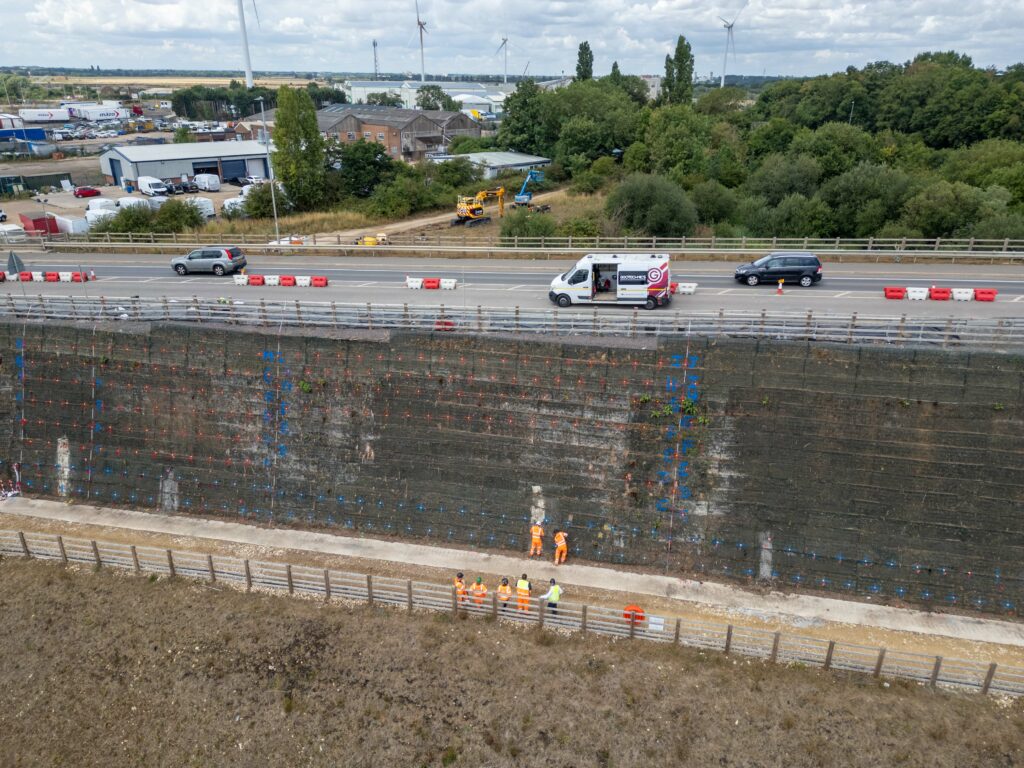
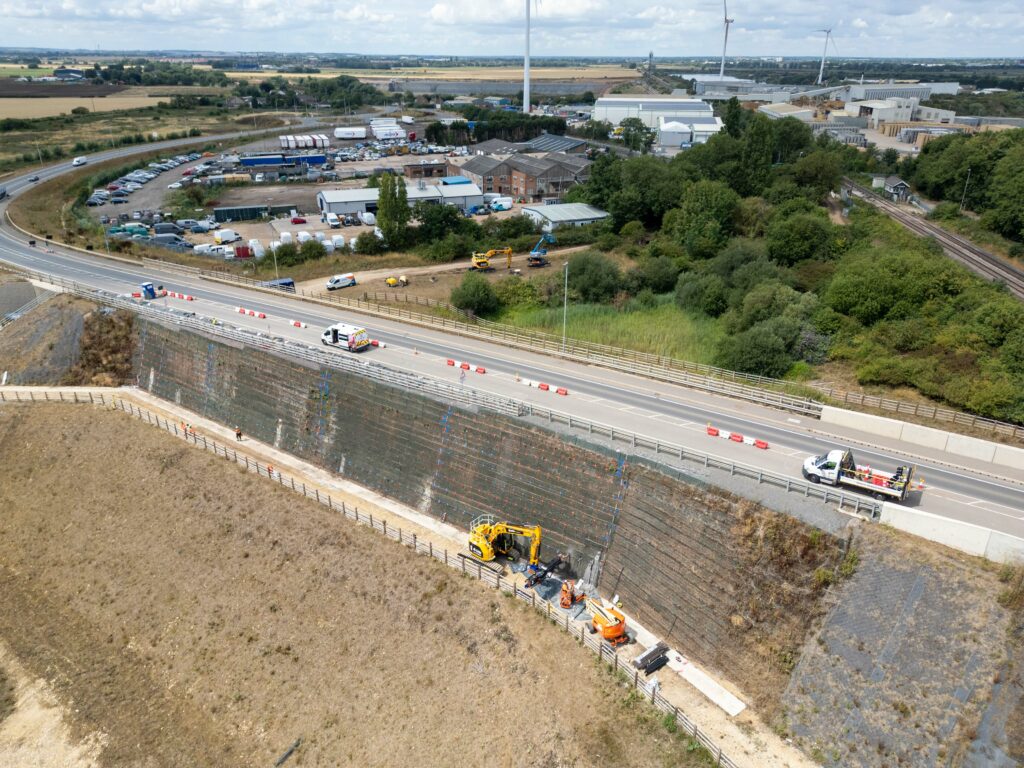
Cracking was first identified on the Ralph Butcher Causeway embankment in July 2024, prompting the introduction of a single-lane restriction for safety reasons.
By October 2024, Cambridgeshire County Council confirmed the presence of “cracking, movement and settlement issues” and advised that restrictions would remain in place pending further investigation.
Additional fractures identified in May 2025 led to an expanded remediation programme overseen by Jones Bros. However, the council later confirmed that progress had fallen behind schedule.
In a public update issued in November 2025, the authority described delays linked to extended soil-nailing works and a late start to sprayed-concrete operations as “not acceptable”, adding that it was applying pressure on the contractor and its subcontractors to accelerate delivery.
Throughout this period, traffic has remained restricted to a single lane.
January 2026 update
In its most recent update, issued on 9 January 2026, the council said Jones Bros had provided what it described as “an extremely disappointing update”, confirming a further delay of approximately one month.
Cold weather was cited as preventing the restart of sprayed-concrete works. Completion is now forecast for the end of February 2026.
The council stated: “This update clearly falls well short of our expectations, and we consider this news to be deeply disappointing.”
It added that it “fully shares the frustration of residents and road users alike”.
Continuining uncertain for road users
The leaked 2019 documents show that long before the Kings Dyke bridge was built, officials had formally recorded concerns about incomplete design, exceptional ground risk, contractor performance and reputational exposure.
Years later, those risks have translated into prolonged traffic restrictions, repeated remediation works and continuing uncertainty for road users.
For residents now facing disruption, the documents raise a central public-interest question: how known risks were managed — and whether earlier warnings were given sufficient weight — before public money was committed and the project progressed.