
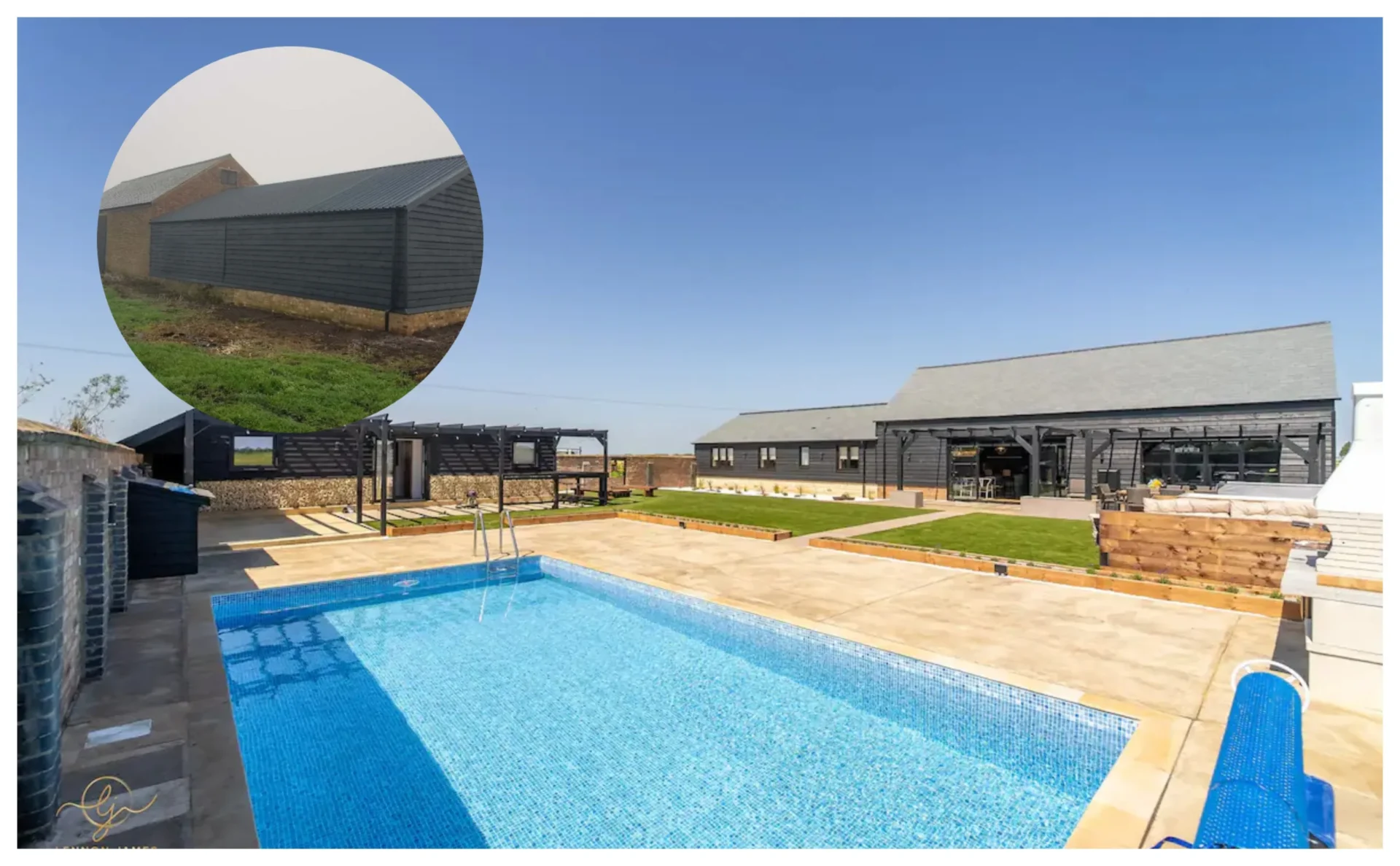
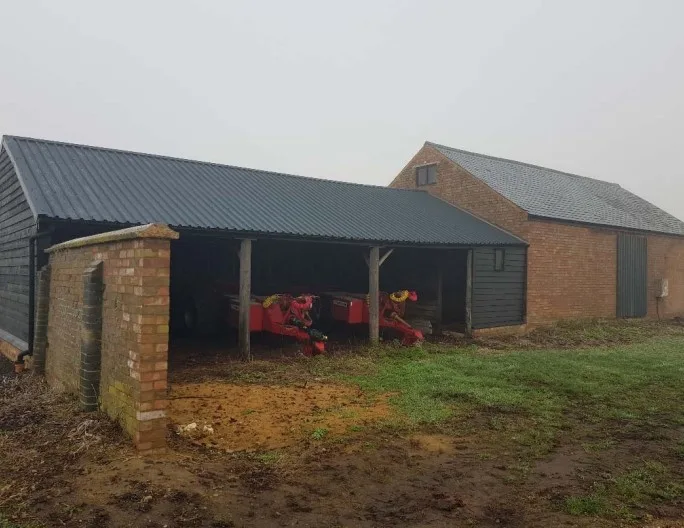
Fenland District Council has refused permission for Wildflower Barn, Stocking Drove, Chatteris, to operate as a large short-term holiday let — ruling that the 16-guest retreat would harm the tranquillity and character of the open countryside.
The retrospective application sought to formalise the change of use of the eight-bedroom property, located around two miles south-west of Chatteris, from a private dwelling to a high-capacity holiday rental.
But council planners concluded that the scale, intensity and transient nature of the operation amounted to a material change of use — one that conflicts with multiple policies in the Fenland Local Plan.
The decision follows objections from residents, the town council, and environmental health officers, with noise, parking shortfalls and highway safety all cited as grounds for refusal.
‘Material change of use’ in quiet rural setting

Wildflower Barn sits in what planning policy defines as an “elsewhere” location — countryside outside any established settlement boundary. Development in such areas is tightly controlled and generally limited to uses essential to agriculture, forestry, outdoor recreation or rural infrastructure.
Council officers found that a commercial short-term let for up to 16 guests did not meet that threshold.
In its formal decision notice, the authority stated: “The proposed use of the dwelling and annexe as a short-term holiday let, accommodating up to 16 guests, is considered to amount to a material change of use.
“This is due to the intensity, scale, and nature of the occupation, including high guest turnover, transient occupancy, and associated activity, which fundamentally alters the character and functioning of the property compared to a single C3 dwellinghouse.”
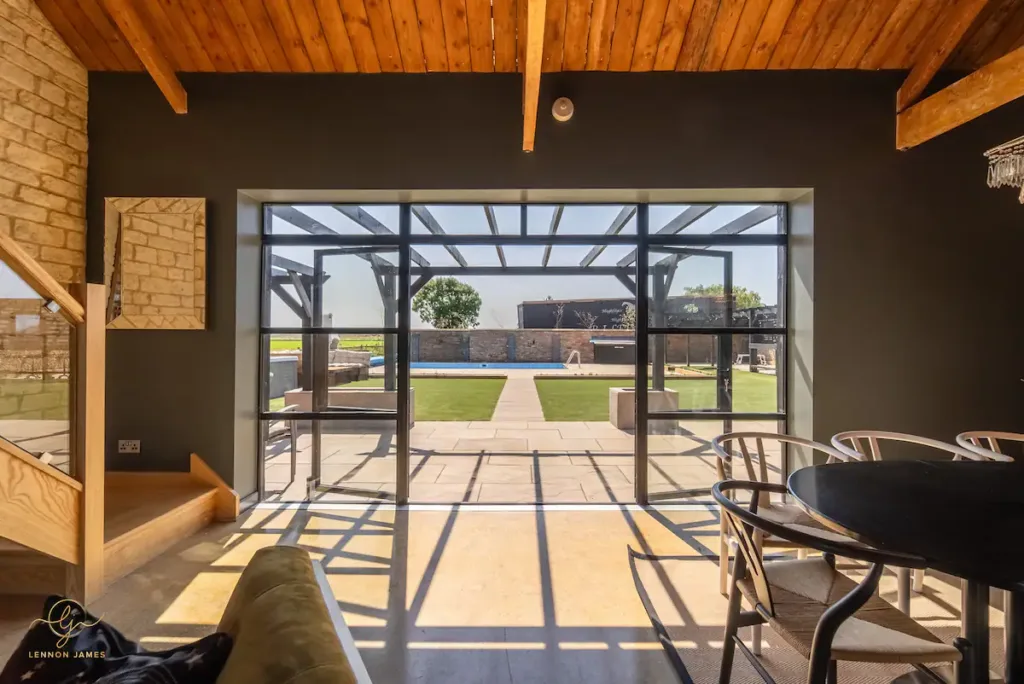
The report emphasised that while a standard family home may host visitors, the marketing and layout of the property — including eight bedrooms, 11 beds and four bathrooms — pointed toward occupation by large, unrelated groups rather than a single household.
Planning officers concluded the use was “sui generis”, meaning it does not fall neatly within existing residential or hotel use classes, because of its scale and impact.
Noise complaints and rural tranquillity at heart of decision
Noise concerns proved central to the refusal.
Eleven letters of objection were submitted, including from residents in Cambridge, Ely, London, Derby and even Dublin, reflecting the reach of interest in the case.
Locally, nearby occupiers raised fears that the property was operating more like a party venue than a home.
Fenland’s Environmental Health team confirmed that complaints had already been received regarding amplified music and raised voices, particularly during evening hours.
The planning officer’s report warned: “The high turnover of transient occupants is likely to generate noise and disturbance, amplified by outdoor amenities and the countryside setting where background noise levels are low.”
In a rural location where, ambient sound is typically minimal, even moderate increases in activity can travel significant distances.
The report added: “It is a reasonable expectation that residents should be able to enjoy their homes without being subjected to undue noise or disturbance… This site is located within a quiet rural area where ambient background noise levels are typically low.
“In such a setting, even modest increases in activity or noise, particularly at antisocial hours, are likely to be more perceptible and potentially disruptive to neighbouring occupants.”
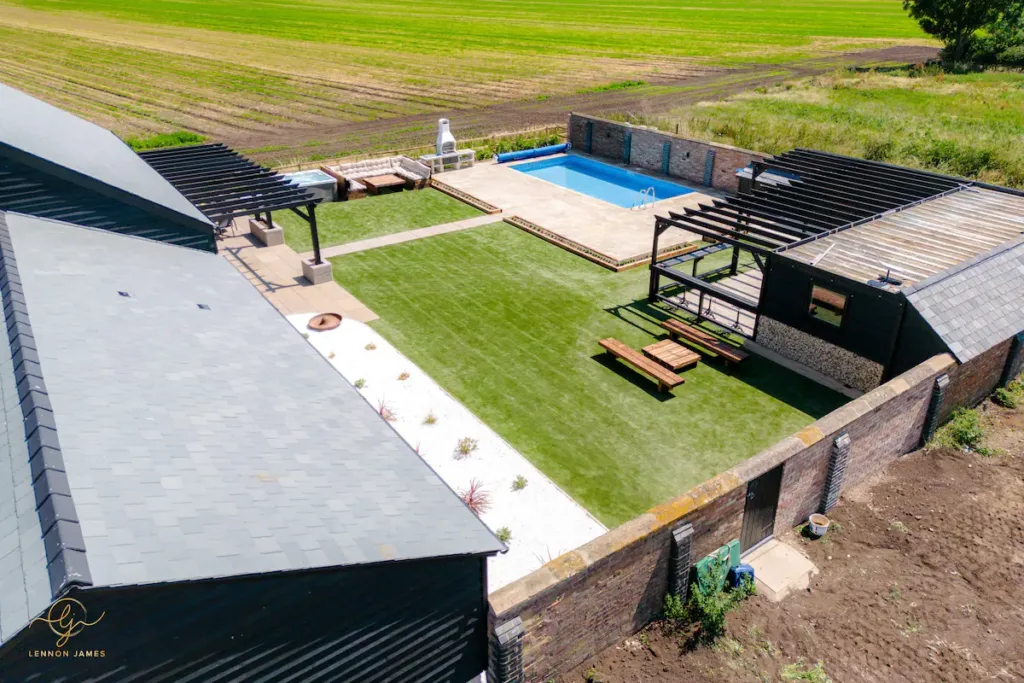
Crucially, officers concluded that conditions — such as noise management plans or restrictions on amplified music — would be difficult to enforce due to the constantly changing guest base and lack of on-site management.
Parking shortfall and highway safety fears
Parking provision was another decisive issue.

The property provides just two on-site parking spaces. For an eight-bedroom holiday let, Fenland’s standards require a minimum of eight.
Council planners described this as a “significant shortfall”, especially given the site’s location on a narrow, predominantly single-track rural road subject to the national speed limit and without public transport access.
VIDEO: Disused barn now 8-bedroom 4 bathroom, £1,000 a night Airbnb
The decision notice stated: “The proposal provides only two on-site parking spaces, significantly below the minimum requirement of eight spaces for an eight-bedroom holiday let… The inadequate parking provision is likely to result in on-road parking, creating an unacceptable risk to highway safety.”
Officers warned that independent arrivals by multiple guests could lead to vehicles being left along the roadside, increasing hazards for passing traffic and agricultural vehicles.
Town council and ward councillor object
Chatteris Town Council recommended refusal, citing incompatibility with the rural setting and concerns about noise and traffic.
Ward councillor Anne Hay also objected, arguing that the property had not been used as a traditional family home and that disturbance levels were out of character with the surrounding countryside.
Residents’ objections referred to fears of antisocial behaviour, light pollution and intensified activity more typical of urban short-let properties than isolated fenland dwellings.
Policy Grounds: Protecting the Countryside
The refusal was grounded in multiple policies of the Fenland Local Plan 2014, including:
- LP3 – Spatial strategy and settlement hierarchy
- LP12 – Rural areas development policy
- LP15 – Facilitating the creation of a more sustainable transport network
- LP16 – Delivering and protecting high-quality environments
Officers concluded that the proposal failed to protect landscape character, local distinctiveness and residential amenity.
The report stated: “From an environmental perspective, the proposal would result in harm to the rural and tranquil character of the surrounding countryside. The intensified use, vehicle movements, and associated paraphernalia alter the character and appearance of the site and its surroundings.”
While acknowledging that short-term holiday accommodation can generate local spending, planners found that any economic benefit from a single property would be negligible and carried “very limited weight” in favour of approval.
Wider debate: tourism vs tranquillity in Fenland
The Wildflower Barn decision highlights a growing tension across rural Cambridgeshire and beyond: how to balance tourism income with the protection of countryside character.
Short-term holiday lets have expanded significantly in recent years, driven by online booking platforms and demand for large-group rural stays. But planning authorities increasingly scrutinise proposals where occupancy levels and turnover resemble commercial operations rather than domestic living.
In this case, Fenland planners determined that the scale tipped the balance too far.
The officer’s report concluded: “The use of the property by large, unrelated groups on a frequent, short-term basis is likely to result in patterns of activity, comings and goings, and levels of occupation which go beyond those associated with normal residential use.”
Right of appeal remains
The applicant, Team C Properties Ltd, represented by MWS Architectural Ltd, has the right to appeal the refusal to the Secretary of State under the Town and Country Planning Act 1990.
The decision notice confirms: “If you are aggrieved by the decision of your local planning authority to refuse permission for the proposed development… then you can appeal to the Secretary of State.”
An appeal must normally be lodged within six months of the decision, though shorter timeframes apply where enforcement action is involved.