
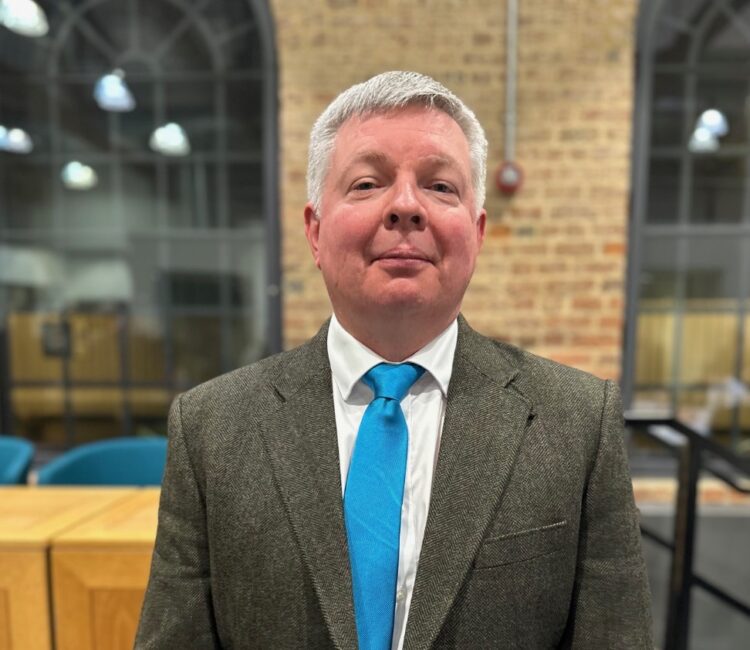
Peterborough’s first Reform UK councillor has outlined an ambitious vision for the city ahead of May’s local elections, promising a shift toward what he calls “serious, professional politics” rooted in local priorities.
Speaking on the Politics of Peterborough podcast with Dave Adcock, Andrew O’Neil used his most detailed public intervention to date to position his party as an alternative to the city’s traditional political leadership.
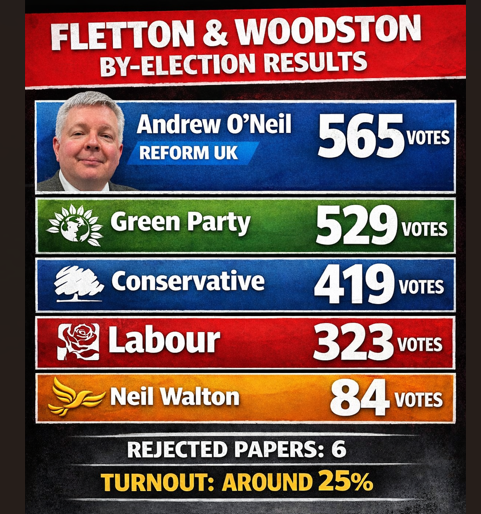
Currently the sole Reform UK councillor on Peterborough City Council, O’Neil said residents were increasingly frustrated with what he described as years of underperformance by both Labour and Conservative administrations.
“Our clear vision is to take care of our residents by supporting them and resolving local issues,” he said. “Residents feel their concerns have been ignored in favour of political grandstanding and vanity projects.”
Criticism of council culture

A central plank of O’Neil’s argument was a sharp critique of the council’s political environment, which he characterised as unprofessional and ineffective.
He accused both the current Labour-led minority coalition and the previous Conservative administration of failing to take scrutiny seriously, describing behaviour in meetings as “childish” and overly combative.
“What we’d see is a return to professional, serious politics that puts residents’ needs first,” he said. “The behaviour seen in full council—mocking questions and trying to score points—undermines the work of the authority and brings local government into disrepute.”
O’Neil argued that stronger scrutiny mechanisms would be central to a Reform-led administration, with councillors taking a more assertive role in holding senior officers and decision-makers to account.
“The executive is there to implement the will of elected councillors,” he said. “We would be far more proactive in scrutiny committees and ensure proper oversight of decisions.”
Spending and financial priorities
Council finances featured heavily in the interview, with O’Neil criticising major capital projects and warning about rising debt.
He singled out the Fletton Quays footbridge—dubbed by critics the “bridge to nowhere”—as an example of spending that should be reassessed. A Reform administration, he said, would review and potentially cancel projects deemed poor value for money.
Instead, he argued, resources should be redirected toward frontline services and infrastructure.
“Residents feel they are paying more in council tax but seeing little or no improvement in services,” he said. “That has to change.”
O’Neil also raised concerns about previous financial decisions, including loans to developers and asset sales. He pointed specifically to a £15 million loan linked to the Hilton Hotel development and the proposed sale of a building used by the Bharat Hindu Samaj temple.
“These are decisions the public has questioned,” he said. “We need to examine whether taxpayers are getting value for money and whether processes have been followed correctly.”
Concerns over community impact
The proposed sale of the building housing the temple was highlighted as a potential flashpoint for community relations.
O’Neil warned that closing what he described as the city’s only Hindu temple—serving around 18,000 people—could have “serious ramifications” for cohesion.
He also questioned the rationale behind the sale, contrasting it with other recent asset decisions.
He said: “The reason given for the sale of the building was to achieve the best possible price. However the Labour led administration have been quite very recently ready to sell off the TK Maxx building at a loss.
“So it’s therefore a bad decision in my opinion and I want to reexamine the processes and procedures adopted behind the decision possibly reversing it.”
Local government reorganisation

O’Neil also addressed the government’s plans for local government reorganisation, which could see Peterborough merged into a larger authority.
While acknowledging potential efficiencies, such as reducing senior management costs, he warned that decision-making could become more remote.
“One risk is that local issues become less of a priority,” he said. “We need to ensure councillors continue to represent their communities effectively.”
Development and infrastructure
On housing, O’Neil struck a cautious tone—supporting growth in principle but stressing the need for infrastructure to keep pace.
He criticised developers for failing to deliver promised facilities on new estates, including GP surgeries and dental practices.
“With a Reform UK administration, there would be no cherry-picking,” he said. “If infrastructure is promised, it must be delivered.”
He also pledged to protect green spaces such as parks and allotments, describing them as vital for health, biodiversity and climate resilience.
Identity and ambition
Despite Peterborough missing out on the UK City of Culture 2029 title, O’Neil said the city should remain confident in its identity.
“We don’t need a title to be proud,” he said, pointing to its Anglo-Saxon heritage, cathedral and museums.
Looking ahead to the 2026 elections, Reform UK hopes to significantly expand its presence on the council. O’Neil framed the party as a response to what he called a “failed” two-party system at local level.
He dismissed concerns about inexperience among potential candidates, citing planned training and support from more seasoned figures.
Transparency and voter appeal
O’Neil also emphasised transparency and public engagement, arguing that decision-making should be as open as possible.
“Everything should be in the public domain where it can be,” he said. “Residents should be able to scrutinise decisions and hold people to account.”
While signalling a willingness to work with other parties if necessary, he stressed that councillors should remain focused on local issues, even where national debates overlap.
In a direct appeal to voters, he pointed to rising council tax, pressure on services and concerns about crime as reasons for change.
“People are paying more and getting less,” he said. “We want to see improvements, accountability and a safer Peterborough.”
The interview offers a clear indication of how Reform UK intends to position itself locally. Whether that message resonates with voters will become clear when the city heads to the polls next year
To listen to Dave Adcock’s excellent backlog of politic interviews go to:
https://www.youtube.com/channel/UCDhaHeNchfpsALrWGvrKCDw