
A major housing development of up to 250 new homes on farmland off Peakirk Road, Glinton, has been approved after a government-appointed planning inspector ruled Peterborough City Council could not meet a key national housing requirement.
The decision has triggered anger and anxiety in Glinton and Peakirk, where residents and parish councils fought hard to protect the countryside gap between the two villages.
But the inspector concluded that the council’s failure to demonstrate a five-year supply of deliverable housing land left national policy weighing heavily in favour of development — despite clear conflicts with the local plan.
As the inspector bluntly recorded: “Its 5 year housing land supply (5YHLS) position is now deficient, and it considers a positive 5YHLS to be extremely unlikely in the foreseeable future.”
That admission, made during the inquiry, proved decisive.

Farmland development wins on appeal
The appeal was brought forward by Gladman Developments Ltd after the city council initially refused planning permission.
The proposal is an outline scheme for:
“The erection of up to 250 dwellings, with public open space, landscaping, sustainable drainage system (SuDS) and vehicular access point…”
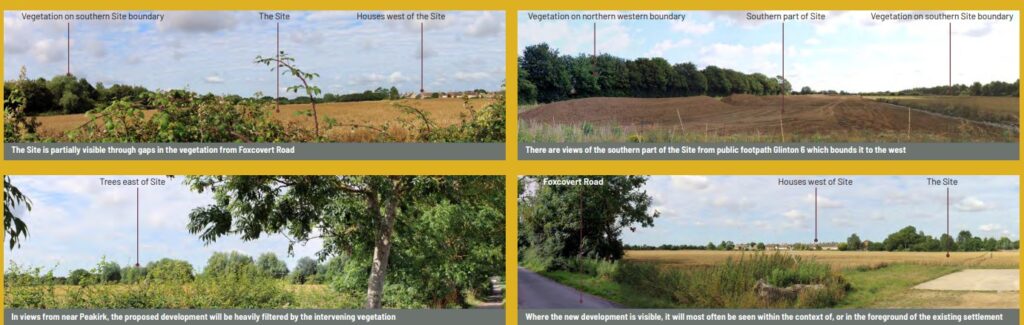
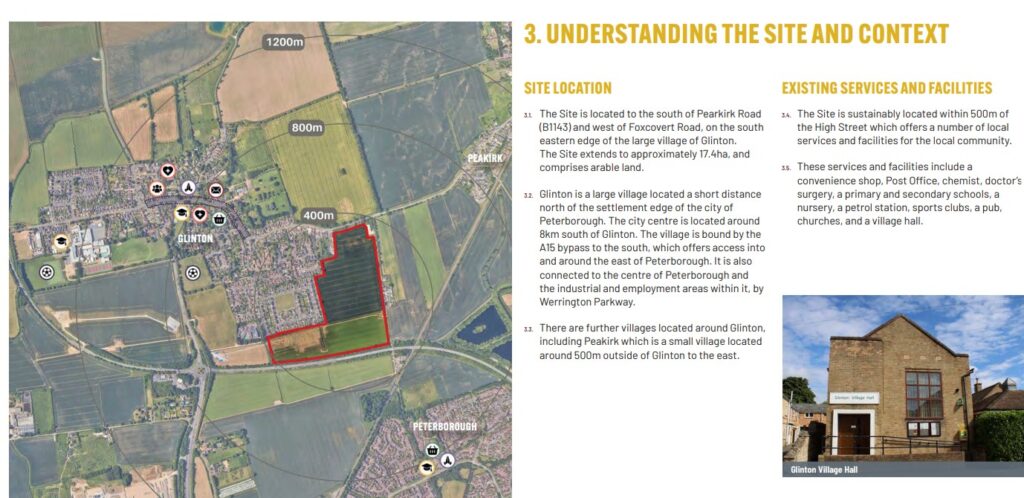
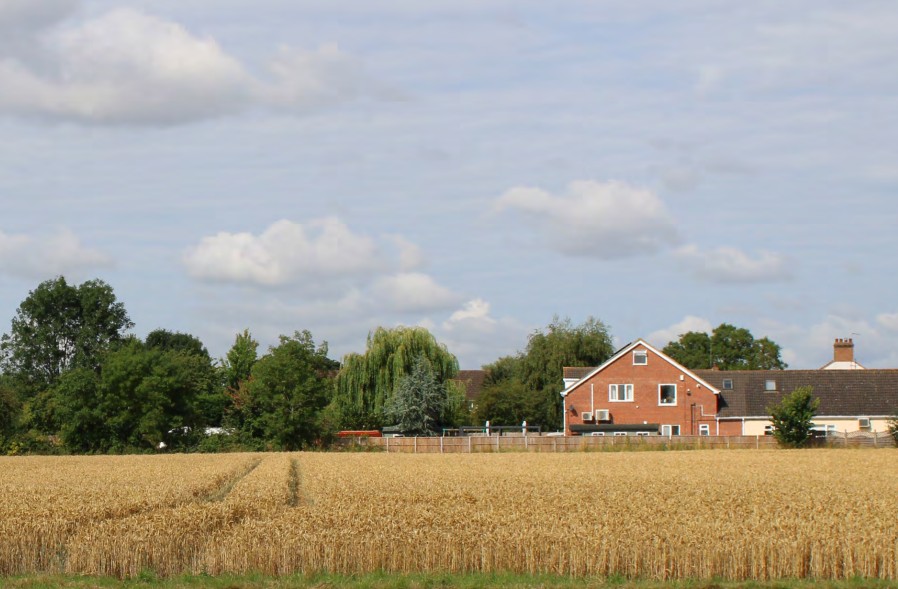
The site consists of arable fields outside Glinton’s settlement boundary — land officially classified as countryside under both the Peterborough Local Plan and the Glinton Village Neighbourhood Plan.
Those plans are designed to limit major growth in rural areas, preserving village character and preventing Glinton and Peakirk merging into one continuous settlement.
Council refusal based on countryside protection
Peterborough City Council’s original refusal was rooted in the site’s countryside designation and the risk of closing the separation between the villages.
The inspector summarised the refusal clearly: “Planning permission was refused because the proposal would lie within countryside… and would result in the erosion of a countryside gap between Glinton and Peakirk.”
Residents argued that approving such a large scheme would permanently change the rural identity of the area.
Dozens of objections were submitted, with parish councils warning of unsustainable growth, overstretched services, and creeping coalescence.
The five-year housing land supply loophole
At the heart of the ruling lies one technical but powerful national requirement: councils must prove they have enough deliverable housing sites to meet demand for the next five years.
This is known as the five-year housing land supply (5YHLS).
If they cannot, the National Planning Policy Framework (NPPF) triggers what is often called the “tilted balance” — meaning applications should be approved unless harm clearly outweighs benefit.
In Glinton’s case, the council conceded its position was weak.
The inspector wrote: “The council has confirmed that it no longer wishes to defend this reason for refusal.”
That opened the door for the appeal to succeed.
Tilted balance tips the decision
Once the five-year supply was found to be deficient, the inspector applied paragraph 11 of the NPPF.
He concluded: “The adverse impacts of granting permission do not significantly and demonstrably outweigh the benefits…”
That sentence sealed the outcome.
The development’s benefits — particularly housing delivery and affordability — were judged to carry more weight than countryside protection policies.
Local Plans overridden
The inspector acknowledged that the proposal directly conflicts with multiple local and neighbourhood plan policies.
He stated plainly: “The proposal’s location, scale and nature would conflict with the LP and GNP…”
Glinton’s neighbourhood plan only supports 34 new homes over 20 years unless the community clearly backs additional growth.
The inspector noted: “The proposal would result in the limit being exceeded with no local support for the proposal.”
Despite that, the inspector ruled national housing need must take precedence.
250 homes including 75 affordable units
A major factor in the approval was the delivery of affordable housing.
The inspector found that providing up to 75 affordable homes carried significant weight: “The benefits of delivering up to 250 new homes… were meaningful and sizeable…”
In the context of Peterborough’s housing shortage, the scheme was seen as a substantial contribution.
Landscape harm accepted — but deemed limited
Opponents argued that building on open countryside would irreversibly damage the setting of Glinton and reduce the village gap.
The inspector agreed harm would occur, writing: “Undeveloped land being built upon… reducing the gap… there would be conflict… albeit the harm would be small in isolation.”
He added: “The development would harm the character and appearance of the area… but such harms… would be localised and small.”
In planning terms, those impacts were not considered severe enough to outweigh the housing benefits.
Heritage concerns dismissed
The inquiry also examined potential impacts on heritage assets, including the Grade I listed St Benedict’s Church.
The inspector concluded the site played only a limited role in its rural setting:
“The appeal site contributes in a very limited way to the understanding of the church…”
He ultimately found: “There would be no harm to the settings of each of these heritage assets.”
Infrastructure pressures raised — but mitigation promised
Residents warned that Glinton’s services — schools, healthcare, roads, drainage — could not cope with 250 homes.
The inspector acknowledged additional demand but noted no provider had objected strongly.
On healthcare, he wrote: “No healthcare provider has commented on the unacceptability of provision…”
On sewerage and water capacity, Anglian Water raised no objection provided conditions were imposed: “Anglian Water has raised no objection… subject to the imposition of conditions…”
A Section 106 legal agreement will secure contributions towards infrastructure such as schools, transport, open space, and mitigation.
A national pattern repeating across England
Glinton’s experience is increasingly common.
Across England, councils struggling to maintain a five-year housing supply are seeing appeals succeed — even on land protected by local plans.
The inspector’s ruling reflects the government’s objective to: “significantly boost the supply of housing.”
What happens next
The permission granted is only outline approval, meaning Gladman must still submit detailed plans covering:
- Layout and design
- Landscaping and biodiversity
- Drainage and highways
- Phasing and delivery
Construction is expected to begin within the next few years.