

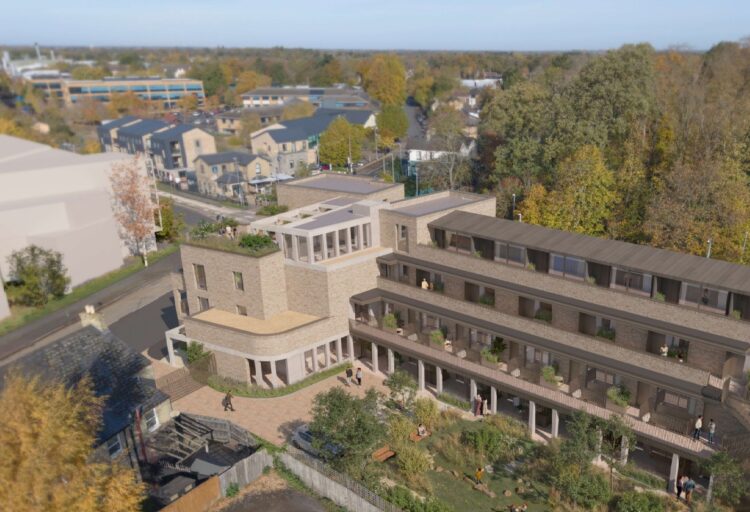
A controversial plan to redevelop Kendal Court in Impington near Cambridge has been formally submitted for planning approval — and it is the number of car parking spaces, not the height of the building, that is driving fierce local debate.
The proposal, lodged with South Cambridgeshire District Council by This Land Development Ltd – the county council owned property company – would see the demolition of the existing buildings on the prominent Cambridge Road corner site and their replacement with a mixed-use scheme of 28 one- and two-bedroom flats above commercial units.
But the headline figure that has caught residents’ attention is this: just four car parking spaces for all 28 apartments.
Impington Parish Council has raised objections, warning the development risks “serious and detrimental overspill parking” into surrounding residential streets unless the parking strategy is reconsidered.
A high-profile gateway site

The Kendal Court site occupies a key position at the junction of Cambridge Road and the guided busway — effectively a gateway into Impington.
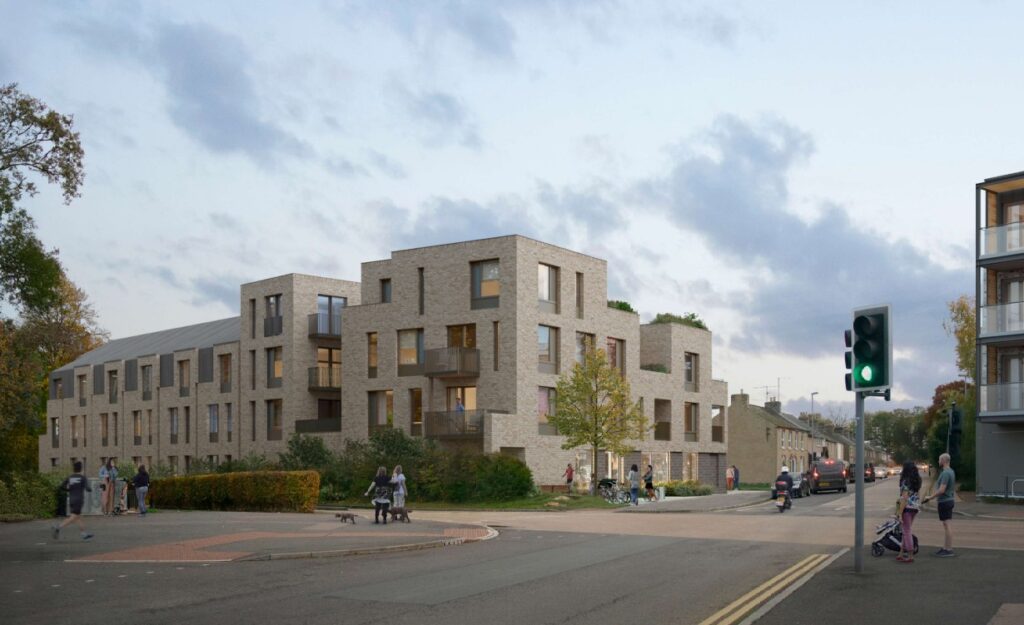
Designed by Haysom Ward Miller Architects, the scheme proposes a predominantly three-storey building, with a four-storey corner element intended to create architectural presence. Landscaped communal gardens and a rooftop amenity terrace form part of what architects describe as a “21st Century exemplar” aligned with sustainability principles in the Local Plan.
The application follows an earlier scheme that was refused and dismissed at appeal. At that time, a Planning Inspector criticised the building’s bulk and dominance along Cambridge Road, as well as insufficient communal amenity space.
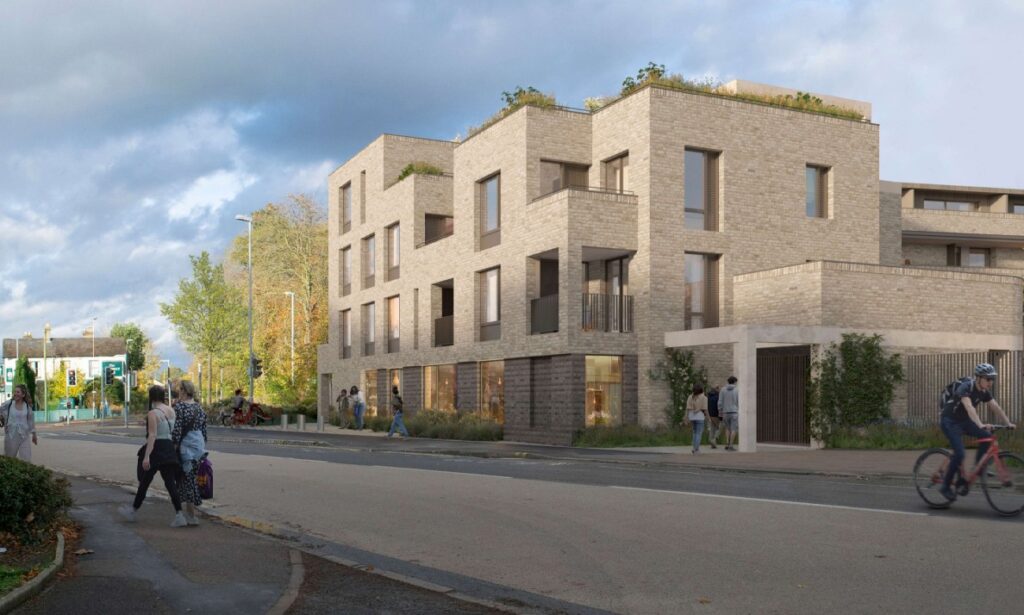
However, significantly for the current debate, the Inspector concluded that a parking ratio of 0.7 cars per flat would be acceptable in principle at this well-connected location.
The new scheme goes even further.
Just four car parking spaces
Instead of allocating parking bays to individual residents, the proposal introduces a car-share model, providing:
- Four communal car parking spaces
- One designated disabled space
- No private allocated resident spaces
For context, South Cambridgeshire’s indicative standard suggests up to two parking spaces per dwelling in some circumstances. The applicant argues that such standards are “indicative guidance” rather than mandatory requirements and must be weighed against sustainability objectives.
The Design & Access Statement states: “This is a residential proposal which promotes sustainable living with reduced car use. It will promote cycling and walking as the principal means of transport.”
Architects point to the site’s immediate proximity to the guided busway, bus stops, shops and local services. They argue that the target demographic — likely young professionals and downsizers — will be less reliant on private vehicle ownership.
Residents purchasing flats, they suggest, will do so in full awareness of the car-light model.
Parish council objections: “overspill is inevitable”
However, Impington Parish Council is unconvinced.
In its submitted comments, the Parish Council raises concerns that:
- Four parking spaces are wholly insufficient for 28 households
- The development will generate overspill parking into nearby residential roads
- Existing on-street parking pressures are already high
- Reduced parking could worsen congestion and safety
Many will argue that while sustainability goals are laudable, real-world car ownership levels remain high in South Cambridgeshire.
Policy vs. parking reality
The dispute highlights a broader planning tension: how far can councils push reduced car parking provision in pursuit of climate and land-use goals?
The South Cambridgeshire Local Plan emphasises sustainable transport and states that developments in accessible locations should prioritise walking, cycling and public transport. The National Planning Policy Framework (NPPF) reinforces this direction, urging decision-makers to reduce reliance on the private car where possible.
The Kendal Court site sits immediately adjacent to high-frequency bus routes and cycle infrastructure — a factor central to the applicant’s case.
The scheme includes:
- 50 secure cycle parking spaces for 28 flats
- Dedicated cargo bike storage
- Visitor cycle spaces
- Landscaped pedestrian-first design
The applicant argues that abundant cycle provision, combined with car-share access, will reduce overall vehicle demand.
Lessons from the refused scheme

Importantly, this is not simply a resubmission of the rejected proposal.
Following the appeal dismissal, the design team undertook substantial revisions:
- Removal of two top-floor flats
- Creation of a rooftop communal garden
- Reduced eaves height
- Stepped building massing along Cambridge Road
- Increased and improved amenity space
Urban design officers previously praised the scheme’s “active frontage” and contemporary appearance, though concerns were raised about scale and visual dominance.
The current submission positions the redesign as a comprehensive response to those criticisms.
Yet while height and massing have been softened, parking provision has become the lightning rod.
The developer’s case: changing demographics
The applicant’s supporting documents suggest the size and type of flats — predominantly one- and two-bedroom units — are suited to residents less likely to require daily car use.
They argue: “The proximity of this development to local networks and services will attract a demographic who will be less likely to own or rely on a private vehicle.”
The model hinges on self-selection: those who require two cars per household simply will not choose to live there.
Car-share schemes have been touted increasingly common in urban developments – although major provider ZipCars has just abandoned the UK market. The long-term success of car-share schemes in edge-of-city locations remains open to debate.
A test case for South Cambridgeshire
Planning officers must now weigh:
- Local parking standards
- Appeal precedent
- Sustainability policy objectives
- Parish Council objections
- Risk of overspill impacts
If approved, Kendal Court could become a benchmark for low-parking developments in well-connected village locations across the district.
If refused, it may signal that rural-edge communities are not yet ready for ultra-low car provision.
Climate goals vs. community concerns
The debate comes at a time when councils face mounting pressure to reduce transport emissions and meet climate targets.
Car parking provision directly influences land use, housing density and viability. Fewer parking spaces can mean:
- More room for homes
- Greater communal space
- Lower development costs
- Reduced hard surfacing
But politically, parking remains one of the most sensitive local planning issues.
For residents, the question is simple: where will the cars go?
What happens next?
The application will be assessed by planning officers at South Cambridgeshire District Council, with a recommendation expected in due course. Given the objections lodged, the proposal could be determined by planning committee rather than under delegated powers.
Should approval be granted, conditions may address:
- Car-share management arrangements
- Parking permit restrictions
- Travel plan monitoring
- Cycle infrastructure delivery
At its heart, the Kendal Court application poses a defining question for Impington: Can a development with four car parking spaces truly serve 28 households — or will reality park itself on neighbouring streets?