
Housing secretary Steve Reed has told Fenland District Council that he will take the final decision on whether a new science park – which the applicants will say will create 1,600 jobs – can be built at Whittlesey.
Mr Reed, only appointed in September as Secretary of State for Housing, Communities and Local Government, dropped his bombshell email on Fenland District Council today just hours before its planning committee were due to meet to discuss the application.
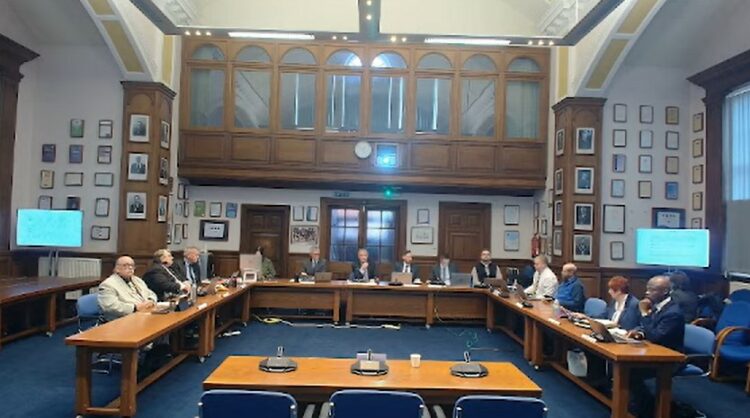
The letter was revealed by senior planner (special projects) Gavin Taylor as the planning committee came together at Fenland Hall, March, to debate the application.
Mr Taylor said the minister had advised he was exercising powers under article 31 of the Town and Country Planning Development Management procedure order.
“The Secretary of State directs the council not to grant permission without specific authorisation; it is to enable him to direct under section 77 of the Town and Country Planning Act that the application should be referred to them for determination,” said Mr Taylor.

However, Mr Taylor said it was important to note the directions that did not prevent the council considering the application or forming an opinion as to the merits of the application or refusing it if so minded.
“In essence the direction should not influence decision making and if this council resolves to grant permission, the Secretary of State needs time to consider call in decision for their own consideration before the council issues any planning permission,” said Mr Taylor.
Councillors continued to debate the application for the science park, planned by Saxon Works Ltd; officers recommended its approval and cited the significant economic benefits, most notably, the creation of up to 1,660 full-time equivalent jobs.
The committee voted in favour of it even though planning officers advised: “There is no planning definition or use class for a Science Park and therefore it would not be possible to impose any conditions or obligations for ‘science and technology’ use per se.
“Notwithstanding, the design and transport ambitions can be reasonably secured and monitored through planning condition, to ensure a high quality and sustainable development comes forward.
“The actual uses of the site will be determined by the tenants occupying the buildings but restricted to those set out in the description of the development and planning conditions.”

The proposed development will see a 45-hectare site on Peterborough Road, currently used for commercial vehicle storage and formerly brickwork pits, transformed into a campus for science and technology-based businesses. The plans include office, laboratory, and manufacturing spaces, renewable energy infrastructure, a country park, and a range of amenities.
Saxon Works Ltd, the applicant behind the science park, is a private company limited by shares, incorporated in England and Wales. Its registered office is at 20 Commerce Road, Lynch Wood, Peterborough, Cambridgeshire, PE2 6LR.
Despite the economic promise, the project faces strong criticism over transport and traffic. The site, bordered by the A605 and near residential streets, is already known for congestion.
The main vehicular access will be from a new arm off the Ralph Butcher Causeway roundabout, with additional pedestrian and cycle access points. Saxon Works Ltd proposes a “mobility hub” to encourage non-car travel, including cycle and scooter hire, car share information, and a shuttle bus to Peterborough station during peak times.
However, local, and regional transport authorities remain unconvinced. Cambridgeshire County Council Highways (CCC) warned, “the site would not achieve a 50% mode share. The applicant is proposing very little in the way of off-site mitigation that will enable and encourage employees to walk/cycle to the site.”
They added, “the modelling shows that in 2034 with 50% mode share the A605 eastern arm will experience queues of 80 metres and with 60% mode share the same arm will experience queues of around 110 metres. This is not acceptable and demonstrates that the proposed development will have a severe impact on the roundabout.”
Peterborough City Council Highways went further, recommending refusal: “The proposed development will result in increased vehicle trips through capacity constrained junctions and no appropriate mitigation measures are being proposed to offset the impact of the development on the network.
“It is considered that without adequate mitigation measures, the proposed development would have an unacceptable impact on highway safety and a severe residual cumulative impact on capacity.”
Active Travel England also deferred support, citing inadequate connections for walking and cycling, and a lack of commitment to improved bus services: “No effort has been made to improve the existing infrastructure from Peterborough which is currently not conducive to walking and cycling to the site. There is also no continuous cycle connection to Whittlesey.” ]
Town council and community views
Despite these concerns, Whittlesey Town Council recommended approval, stating simply: “No objection. Recommend approval.”