
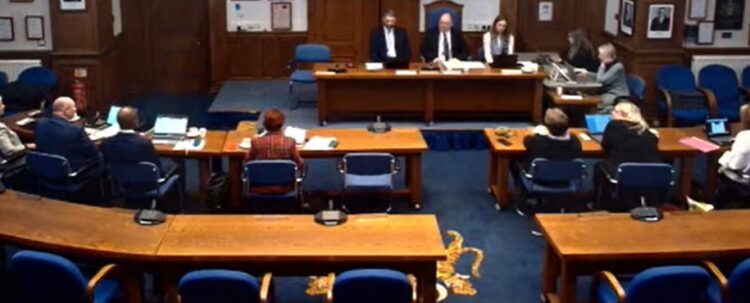
A month-long public consultation. Fifty responses. That was the level of public engagement behind the newly approved 2026-27 Business Plan adopted by Fenland District Council on Monday, February 23.
Cabinet voted to sign off the strategic blueprint for the year ahead — a document setting out ambitions across communities, environment, economy and organisational reform — despite participation in the district-wide survey amounting to a fraction of one per cent of Fenland’s 100,000-plus population.
The consultation ran from January 5 to February 1 and was promoted online, through social media and via stakeholder networks..
Yet only 50 people responded.
“It was publicised on the front page of our website, our news web page and FDC social media accounts, via press releases and circulated to our news distribution list,” Cabinet was told.
“It was also circulated to our business contacts, community groups and hard to reach groups. It was also available in paper format at the South Fens Business Centre, Chatteris, the Boathouse Business Centre, Wisbech, and Fenland Hall, March.”
Big themes, broad language
The Business Plan 2026-27 identifies four corporate priorities:
- Communities
- Environment
- Economy
- Quality Organisation
Alongside those sits the continuing Fenland Inspire! investment programme and a cross-cutting “Transformation” agenda designed to modernise how the council works.
On paper, the ambitions are sweeping: supporting vulnerable residents, boosting economic growth, enhancing green spaces, attracting investment, improving customer experience and preparing for looming local government reorganisation.
But beyond the headline themes, the document lacks specifics.
Phrases such as “driving positive change”, “maximising outcomes”, “ensuring resilience” and “enhancing customer experience” appear repeatedly.
What is less common are firm delivery dates, detailed cost breakdowns or measurable targets that residents can easily track.
Consultation: 50 voices shape a district plan
The council describes the consultation as district-wide and open to all.
Of the 50 respondents:
- 82% supported environmental ambitions
- 70% supported community priorities
- 67% supported economic ambitions
- 67% supported the Quality Organisation objective
- 58% supported the Transformation agenda
- 49% supported the Fenland Inspire! projects, with 33% unsure
On paper, that suggests majority backing.
In raw numbers, however, it means around 25 people expressed support for Inspire projects — and roughly 16 said they were unsure.
For a capital programme involving millions of pounds of public money, that is a slender evidence base.
No demographic breakdown has been publicly detailed to show how representative those 50 respondents were of Fenland’s age profile, geography or socio-economic mix.
Council Tax freeze — eighth year running
One headline commitment remains politically potent: a proposed freeze in the council’s share of council tax for the eighth consecutive year.
Council Leader Chris Boden framed this as proof of “careful and responsible financial management” during continued pressure on local government finances.
For households, the freeze means no increase in Fenland District Council’s portion of the bill.
Pride in Place: £1.5 million — but where?
One tangible change to the draft plan followed a Cabinet decision in December 2025.
A £1.5 million “Pride in Place Impact Funding” allocation from Government has been repositioned under the Environment priority.
The revised wording commits to: “Use the £1.5million Pride in Place Impact Funding from Government to deliver improved open spaces and play parks across the district, enhancing facilities in line with the aims of the Fenland Inspire! project.”
But the Business Plan does not list which parks will be upgraded, how locations will be prioritised, what equipment will be installed, or when residents will see works begin.
Is funding spread evenly across market towns and villages? Focused on areas of deprivation? Tied to match-funding?
Those answers are not in the document.
Fenland Inspire!
The Fenland Inspire! programme contains some of the clearest physical proposals.
These include:
- Development of new multi-use sports pitches, potentially including 3G artificial turf
- Assessment of Chatteris Leisure Centre
- Redevelopment progression at Manor Leisure Centre in Whittlesey
- Restoration work at St John’s Graveyard Chapel in March
- Improvements around Wisbech Park
- Securing land for a country park in March
- Village green ambitions in Wimblington
Costings, timelines and confirmed funding streams are not fully laid out in the Business Plan itself.
Which schemes are shovel-ready? Which depend on external grants? What happens if partner funding does not materialise?
Again, the document outlines intent more than delivery schedules.
Wisbech: £20 million regeneration — eventually
Perhaps the most eye-catching figure in the plan relates to Wisbech regeneration.
The council references up to £20 million over ten years via the Government’s “Plan for Neighbourhoods” initiative, overseen by the Wisbech Town Board.
The aim: enhance the town centre, boost economic growth and improve opportunities.
But there is no project-by-project breakdown in the Business Plan.
No list of specific buildings, streets or business initiatives.
No phasing plan.
No outline of early wins.
The headline number is significant, but the detail remains to be fleshed out.
Transformation: direction, not blueprint
The Transformation agenda underpins the entire plan.
Stripped of jargon, it centres on:
- Expanding online self-service
- Improving customer experience
- Training and retaining staff
- Encouraging joined up working across departments
- Finding efficiencies
Yet it does not specify which services will move online next.
It does not state whether any face-to-face services will reduce.
It does not list quantified savings for 2026-27.
Nor does it outline measurable targets such as reduced call waiting times or complaint response times.
Reorganisation looming
All this comes against the backdrop of potential local government reorganisation, which could see district councils replaced by new unitary authorities by 2028.
The Business Plan acknowledges reform concerns — including scope, cost and impact on local identity — while accepting change is likely.
But it raises practical questions:
- Will major projects survive structural reform?
- Could governance changes delay regeneration schemes?
- How much officer time is now being diverted into preparing for reorganisation?
The plan does not quantify that either.
The bigger question: engagement
Perhaps the most striking statistic remains the simplest.
A month-long consultation. Fifty responses.
In a district of over 100,000 people.
Was that apathy? Consultation fatigue? Insufficient promotion? Or quiet satisfaction?
The council can point to majority support within those responses.
But the numbers are so small that they offer only a limited snapshot.
Fenland District Council’s Business Plan 2026-27 was approved on Monday, February 23.