
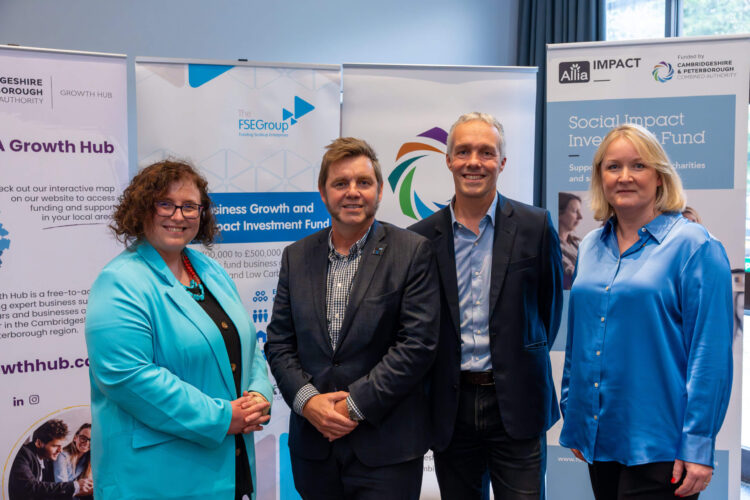
As the Cambridgeshire and Peterborough Combined Authority (CPCA) funding committee meets on December 8, the future of the region’s £2.37 million business growth and social impact fund (Stream 2) is under serious threat.
The push for early closure does not stem from lack of performance, but from a shift in strategic priorities under Mayor Paul Bristow, who since taking office in May has steered the CPCA toward backing fewer, larger and more centralised projects.
The change could cut off vital support for dozens of smaller social enterprises and community groups that have relied on the fund to drive local impact.
A report to the funding committee says: “As part of the Mayor’s review of current programmes and projects across whole of CPCA, the business growth and social impact fund was found to not align with the new Mayoral priorities as set out in the Mayor’s manifesto, which have been transitioned and embedded as objectives into the CPCA Corporate Plan.
“The Mayor wants to use funding to do fewer things better, concentrating on delivering a handful of strategic schemes, rather than having pots for multiple projects, investments or grants.”

The report adds: “He also noted the risks of early-stage investment or funding, which depends on trying to pick winners.
“The conclusion from the review is that this programme does not align with the new Mayoral priorities and this therefore results in this formal request to the funding committee to consider whether or not to cancel this contracted programme that started delivery in September 2024 and is contracted to run for 3 years during the awarding/investing period of this part of the programme.”
Launched in September 2024, the fund was designed to fill a long-acknowledged gap in finance for third sector organisations.
Managed by Allia Impact Ltd, it aimed to support job creation, social innovation, environmental improvements and cross-sector partnerships across Cambridgeshire and Peterborough.
The fund was aimed at providing grants or loans to third sector businesses that do not have access to funding from other sources. The project was allocated c.£2.375m of funding available over a 3-year funding period and offered as grants to maximum of £25,000 and loans between £10,000 – £75,000.
By October 2025, its impact was clear. The fund had committed £591,455 across 14 grants and five loans and attracted 149 expressions of interest from organisations eager to grow.
Beneficiaries were spread across the region, including Peterborough (33%), Fenland (19%), Cambridge (14%), South Cambridgeshire (13%) and Huntingdon (21%).
One successful applicant, Helping Whittlesey, was able to secure additional funding from National Lottery Community Fund and Whittlesey St Andrew’s Masonic Lodge to establish a Rent & Return infrastructure to expand community reuse initiatives and reduce waste.
Another applicant, CCORN, received grant funding to establish Fenland’s first Maker Space. They also succeeded in obtaining additional funding from Groundwork UK for solar panels, 3-phase electric installation, and infra-red heating.
Another loan applicant, People and Animals CIC, received match funding from Clarion Futures (£81,867) and Anglia Water (£60,000) to complement the CPCA loan to purchase land to expand their services for underprivileged communities.
However, more than £150,000 in applications currently in due diligence may never reach approval if the programme is shut down.
The CPCA is weighing two closure options: ending the scheme in September 2026 or exiting immediately before the end of 2025 — the latter carrying the most severe consequences.
The programme “does not align with the new Mayoral priorities and the new CPCA corporate plan objectives,” says the report.
“The Mayor’s office has directed the consideration of options to cancel the programme which includes inviting and investigating a mutually agreed early exit than what the existing contract allows.
“An earlier exit would result in CPCA retaining more capital, which can then be reallocated for strategically significant use. It also reduces the investment risk associated with the programme.”