
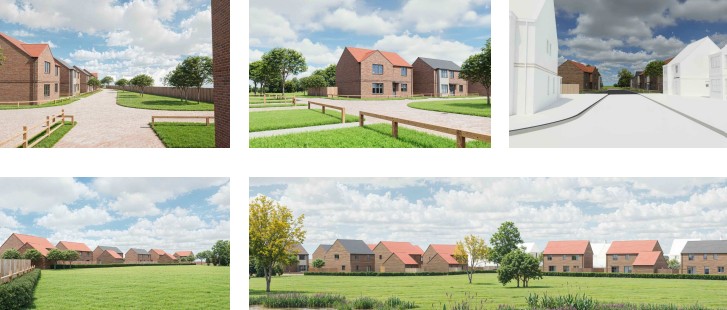
Fenland District Council planning officers have recommended approval for a controversial housing development on land east of Berryfield in March, despite the scheme delivering no affordable housing and no Section 106 contributions.
The proposal for 15 homes, submitted by Fink Developments and designed by Swann Edwards Architecture, has prompted objections from March Town Council and local residents, who argue the development fails to meet community needs and relies on disputed viability evidence.
Nonetheless, officers say an independently reviewed financial assessment leaves the council with little justification to refuse the scheme. The council planning committee will determine the application on January 14.
Viability at the Centre of the Dispute
Under Fenland Local Plan policy, developments of this size would normally be required to provide 20 per cent affordable housing and contribute towards local infrastructure through S106 payments. In this case, neither is proposed.

The officer’s report confirms that a viability assessment — independently reviewed on behalf of the council — concludes the development cannot support either obligation. Even without affordable housing or S106 contributions, the scheme is said to generate a negative residual land value.
According to the review:
- Applying full policy requirements results in a residual land value far below the benchmark land value.
- Even with zero policy contributions, the scheme shows a deficit of approximately –£108,700, compared with a benchmark land value of £481,000.
- Sensitivity testing indicates that reasonable changes to market conditions would not materially improve viability.
- The only way the scheme could proceed would be if the developer accepted profits significantly below market norms.
Officers acknowledge the outcome is “regrettable”, particularly given Fenland’s acute need for affordable housing, but conclude that insisting on contributions would likely make the scheme undeliverable.
“A viability assessment, independently reviewed by the council, concludes that the development cannot viably support either affordable housing or S106 contributions,” the report states. “The omission of contributions is therefore accepted.”
Revised Scheme Follows Earlier Refusal
The application follows the refusal of an earlier 18-dwelling scheme, rejected in January 2025 due to flood risk and biodiversity concerns. Planning officers say the revised proposal has been significantly amended to address those issues.
The number of homes has been reduced to 15, all built development has been relocated into Flood Zone 1, and land within higher flood risk areas is now proposed as public open space, including a surface water detention basin.
“The revised scheme follows the refusal of an earlier proposal for 18 dwellings,” the officer’s report notes. “Key amendments include a reduced quantum of development and relocating all built form into Flood Zone 1.”
Officers confirm that flood risk objections have been overcome and that the scheme now delivers biodiversity net gain.
Housing Mix and Design Concerns
The development comprises three- and four-bedroom houses only, with no smaller units. While officers accept that this does not reflect the district’s identified housing needs, they argue the issue does not justify refusal.
“Although the scheme does not fully reflect the District’s identified need for smaller homes, this was not a previous reason for refusal and is not considered to warrant objection,” the report says.

Design-wise, the scheme mirrors the neighbouring Berryfields estate, using similar materials and layout principles. Officers conclude there would be no significant harm to residential amenity or the wider landscape.
Strong Local Opposition
March Town Council has objected to the proposal, raising concerns about flood risk, traffic, loss of agricultural land, and the lack of affordable housing and community contributions.
Local residents have also submitted detailed objections, with one resident at 23 Berryfield challenging the accuracy of the viability review. They argue the report references incorrect local sales data and should not be relied upon.
“Given that the information contained within this Independent Viability Review is factually incorrect, you should question the viability of the remaining contents of the report,” the resident wrote.
They urged councillors to commission a separate council-led viability assessment before agreeing to waive S106 obligations.
The resident also highlighted the toll of prolonged development in the area, adding: “Enough is enough. Five years to build less than 28 houses is causing us health issues.”
Officers responded that it is reasonable to consider nearby property sales when assessing likely values and that the applicant’s figures have already been independently reviewed.
Planning Balance Tips in Favour of Approval
In weighing the application, officers identify modest economic benefits from construction, additional housing in a sustainable location, and environmental improvements through flood mitigation and open space provision.
These benefits are set against the absence of affordable housing, lack of S106 contributions, and a housing mix that does not fully align with policy aims. On balance, officers conclude the scheme remains acceptable.
“On balance, the benefits are considered to outweigh the identified harm,” the report concludes.
Decision Rests with Councillors
The Berryfield development has become a flashpoint for wider concerns about viability-led planning decisions and the erosion of affordable housing policy. While officers say refusal would be difficult to defend, residents argue the community is being short-changed.
The final decision now lies with Fenland District Council’s planning committee, which must decide whether to accept the officer recommendation or heed calls for a tougher stance on developer viability claims.