

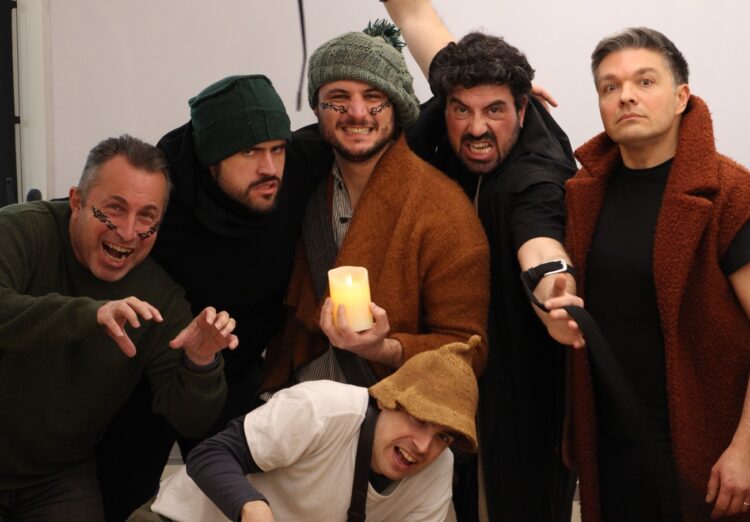
When women are subjected to violence by men, then elements of the fantastical come to their minds – and come to their rescue. So says the director of this year’s Italian play at Cambridge University, Ludovico Nolfi.
Once upon a time, fairy tales and other stories travelled from voice to voice and from hearth to page, carrying the power to awaken fear and desire.
This year’s play Tessitrici di Fiabe (The Fairytale Weavers) draws on the great Italian fairy-tale tradition that later spread across Europe.
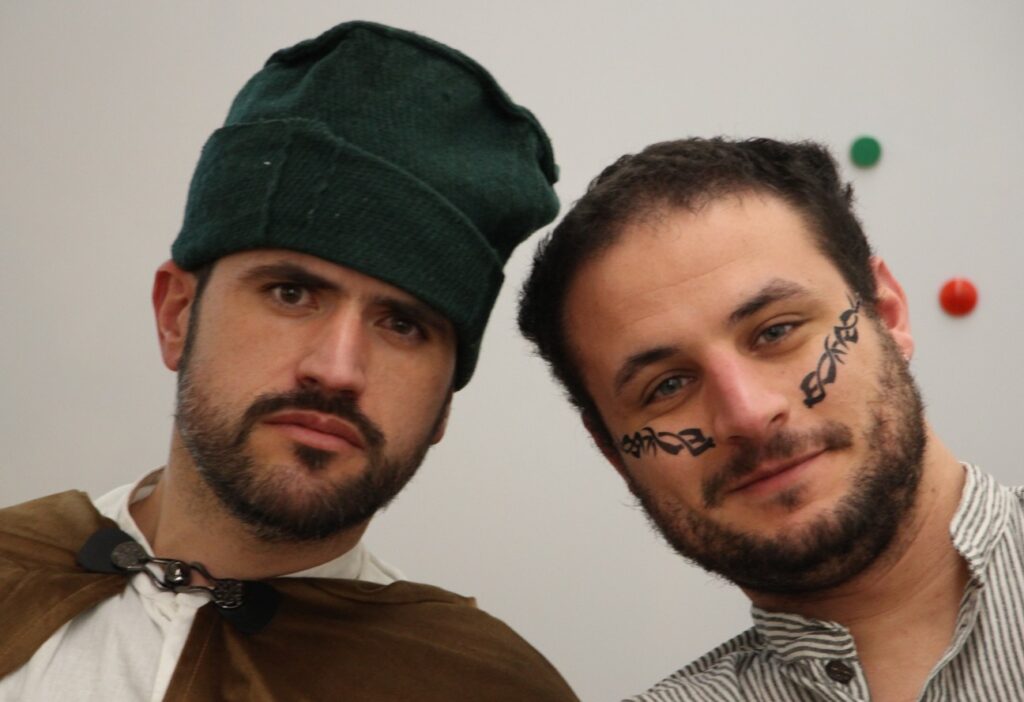
At the heart of the play stand Italian women who passed down fairy tales around the fireplace and within the domestic spaces of their everyday life. Their stories were filled with hopes and struggles, with abductions and ordeals.
Through these tales, says Nolfi, they confronted the shadows of oppression and violence. “Women’s courage lies at the centre of the staging, casting light on their imaginative narratives as a path towards justice and a way of reclaiming an alternative destiny.”
Tessitrici, (The Fairytale Weavers) based on these traditional fairy tales, has been adapted by Nolfi with Elena Sottilotta, a research fellow at Cambridge who specialises in the history of folklore and children’s literature.
She is the author of Seekers of Wonder: Women Writing Folk and Fairy Tales in Nineteenth Century Italy and Ireland.
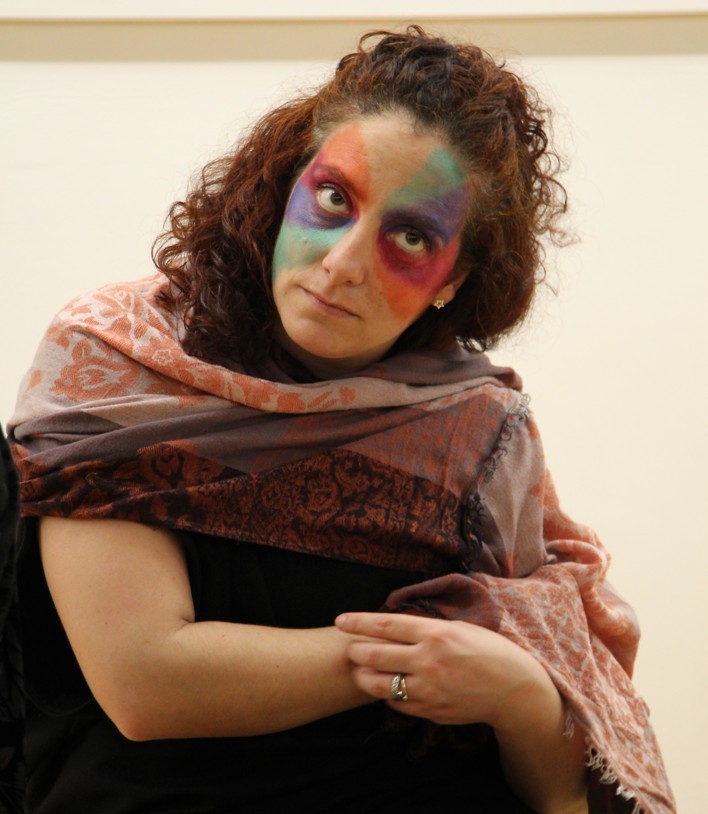
The Italian Play is presented annually by Cambridge University Italian Society and for the past few years has been directed by Ludovico Nolfi, artistic director of the international theatre company Ars in Fieri.
The cast includes native and non-native speakers performing in Italian with captions in English.
The performance is inspired by the seventeenth century Tale of Tales, the baroque masterpiece of Neapolitan fairy tales by Giambattista Basile and also by the great nineteenth-century collectors of Sicilian folklore Laura Gonzenbach and Giuseppe Pitrè.
Many of the tales Pitrè recorded were told to him by Agatuzza Messia, a gifted Sicilian storyteller whose voice still resonates through these narratives.
Says Nolfi: “At the heart of the production are women narrating fairy-tales. We are presenting Cinderella and Rapunzel with a twist of feminism. Added to this, La Serpe (The Snake), a fairy-tale that begins with a young farm-girl who has been attacked by a prince. In this story, the girl manages to avenge herself with the help of a snake.
The women win in the end, assisted by flora and fauna. There is a lot of humour in our retellings and also moments to make you think.”
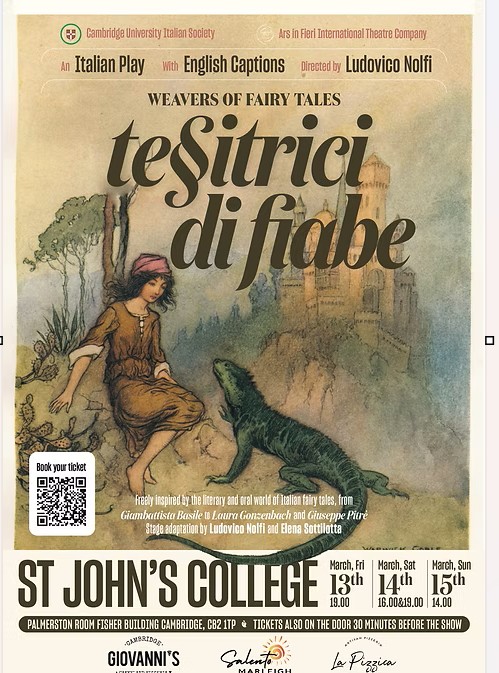
Tessitrici (The Fairy Tale Weavers) is at St John’s College, Cambridge at 7pm on Friday, March 13 and Saturday March 14, with matinees on the Saturday at 4pm and Sunday, March 15 at 2pm. Tickets from: the link: Buy tickets – Tessitrici di Fiabe Buy tickets –