
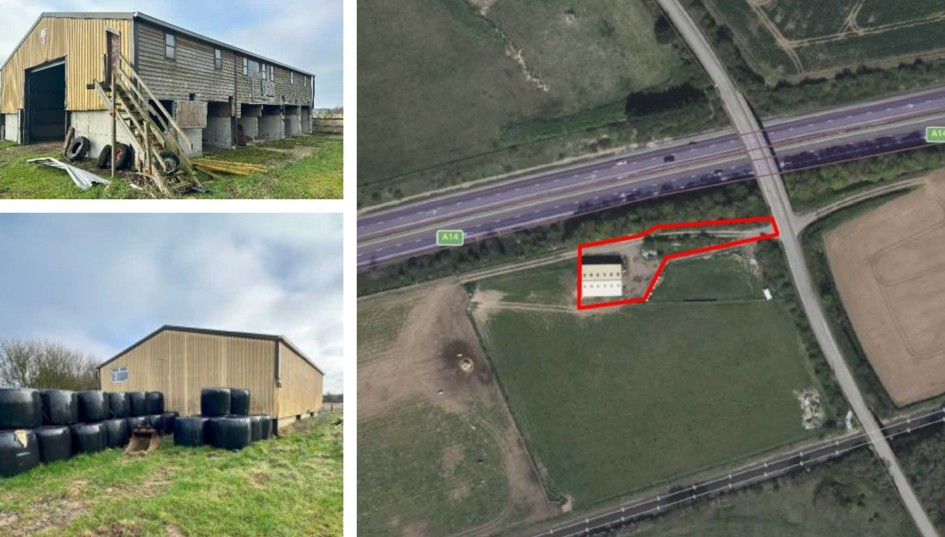
Plans to convert a rural barn into two homes have been thrown out after a planning inspector warned future residents would effectively have to live with their windows shut to escape noise from the nearby A14.
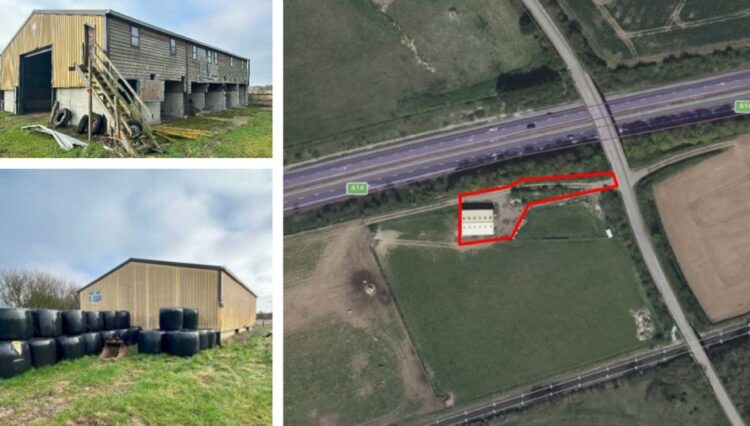
The proposed conversion at Nerries Farm, beside Norwich Road in Kennett, Suffolk, was rejected after an appeal found the location too noisy to provide acceptable living conditions.
A government-appointed inspector ruled the building’s proximity to both the A14 dual carriageway and nearby railway lines would create an environment where occupants would need to rely on mechanical ventilation rather than opening windows for fresh air.
The decision brings an end to the latest attempt to turn the agricultural building into housing after East Cambridgeshire District Council previously refused prior approval for the scheme.
Traffic and train noise “clearly audible”

Planning inspector A Hickey visited the site before issuing the ruling.
In the decision, the inspector described how the building sits extremely close to major transport infrastructure.
“The appeal site comprises an isolated agricultural building… in close proximity to the A14, a busy dual carriageway separated from the site by a planted embankment,” the report states.
Railway lines also run nearby.
During the site visit, the inspector noted that noise from both the road and rail corridor was obvious.
“During my site visit, noise from both sources was clearly audible.”
A noise impact assessment found that traffic from the A14 to the north and trains from the south would affect all sides of the building.
Windows would have to stay shut
Developers had proposed installing specialist acoustic glazing and a mechanical ventilation system to make the homes viable.
But the inspector concluded that mitigation measures would effectively require residents to keep windows closed most of the time.
“To mitigate the identified noise sources, windows and doors would need to be kept closed,” the decision states.
The report added that fresh air would be supplied through mechanical ventilation systems rather than natural airflow.
The inspector ruled that arrangement would not provide an acceptable quality of life for future occupants.
“In my view, future occupiers would be harmed as a result of them being unable, or potentially unwilling, to open windows as a result of experiencing relatively high levels of noise and disturbance,” the report says.
Noise problems would also continue overnight, the inspector added.
Mechanical ventilation “not a desirable choice”
One of the central concerns raised in the decision was the reliance on mechanical systems rather than natural ventilation.
The inspector said this would be an undesirable situation for people living in the converted building.
“I find that reliance on mechanical ventilation to obtain fresh air, rather than opening a window, would not be a desirable choice for future occupiers.”
Local authority planners had raised the same issue earlier in the process.
Council officers noted that the acoustic report submitted with the application found acceptable noise levels could only be achieved if windows were closed permanently.
Their report warned this would create “a less than desirable method of living through the inability to open windows”.
Officials also said mechanical systems can fail or require maintenance, potentially leaving residents with little choice but to open windows and experience high levels of noise.
“A failure on the part of the equipment could result in pressure for future occupiers to open windows which in turn creates noise harm from the high decibel levels established from neighbouring emitters such as the motorway,” the council report stated.
Lack of garden space raised further concerns
Noise was not the only issue highlighted by planners.
The proposed homes would also have lacked dedicated private outdoor space — something the inspector said would normally be expected in rural housing.
Plans showed that the land around the building would largely be used for vehicle access and parking.
“Future occupiers would have no dedicated private amenity space, which would be a reasonable expectation in this location,” the inspector said.
Even if residents attempted to use the surrounding area outdoors, the inspector said noise from the A14 would still make it unsuitable.

“It would be a shared space for vehicular parking and turning and subject to unacceptable noise impacts from the A14.”
Council planners had earlier raised similar objections, stating it would be “wholly inexcusable” to support family-sized homes without basic outdoor amenities.
Officers said the absence of garden space would prevent normal activities such as sitting outside or drying clothes.
Appeal argued other homes exist near dual carriageways
The applicant argued that other homes already exist close to dual carriageways, suggesting the location should not automatically rule out residential use.
Examples along Snailwell Road were cited during the appeal.
But the inspector said each planning application must be judged on its own circumstances.
“I do not have full details of those developments, and in any event, each proposal must be assessed on its site-specific circumstances.”
The presence of nearby properties close to busy roads therefore did not outweigh the concerns about noise and living conditions at the Nerries Farm site.
Planning policy requires good living conditions
Ultimately, the decision rested on whether the location made residential use impractical or undesirable under national planning rules for agricultural building conversions.
Under permitted development regulations known as Class Q, agricultural buildings can sometimes be converted into homes without full planning permission.
However, local authorities must assess several factors, including transport impacts, flooding risk, design and noise.
The inspector concluded the location failed one of the key tests.
“Therefore, the proposal would fail to provide a suitable standard of living conditions for future occupants in respect of noise exposure.”
Planning decisions, the inspector added, must ensure “a high standard of amenity for future users”.
Because of the noise environment and lack of outdoor space, the conversion did not meet that standard.
Appeal dismissed
The ruling means the barn cannot be converted into the proposed two homes under permitted development rules.
The inspector concluded the site’s location next to major transport routes made residential use inappropriate.
“I conclude that the location and siting of the building make it otherwise impractical and undesirable to change from agricultural use to a use falling within Class C3 (dwellinghouses).”
As a result, the appeal was dismissed and the council’s refusal stands.
Previous attempt also refused
The site has a history of unsuccessful attempts to convert the building.
A previous proposal to turn the agricultural structure into a dwelling was refused in 2014.
That earlier scheme was rejected partly due to insufficient evidence that the building formed part of an established agricultural unit at the relevant time.
While the latest application overcame that hurdle, it ultimately failed on the issue of living conditions.
Wider debate over barn conversions
The case highlights ongoing tensions surrounding the conversion of rural agricultural buildings into housing.
Class Q rules were introduced to increase rural housing supply by allowing certain barns to be turned into homes without full planning permission.
But councils and inspectors can still block proposals where location or design issues mean the homes would offer poor living conditions.
In this case, the combination of constant traffic noise, reliance on mechanical ventilation and the absence of outdoor space proved decisive.
For planners, the verdict underlines a basic principle.
Even when planning rules allow buildings to be converted, they must still provide a place where people can reasonably live — with the simple option of opening a window.