
Cygnet Bridge didn’t appear overnight. Its story began six years ago, in a strategic transport plan aimed at making Peterborough more walkable, cycle-friendly, and connected.
In January 2020, the Cambridgeshire & Peterborough Combined Authority (CPCA) formally approved its first Local Transport Plan, which set out how walking, cycling, and public transport could support growth, health, and regeneration across the region.
At the time, the decision was taken under Mayor James Palmer, following public consultation and committee scrutiny.
Among its priorities, the plan highlighted a challenge for Peterborough: the River Nene acts as a physical barrier. Existing crossings are widely spaced and often designed primarily for motor traffic, making every day journeys longer and pushing residents towards car use, even for short trips.
The plan supported new pedestrian and cycle bridges over the river to improve connectivity.

Turning principle into a project
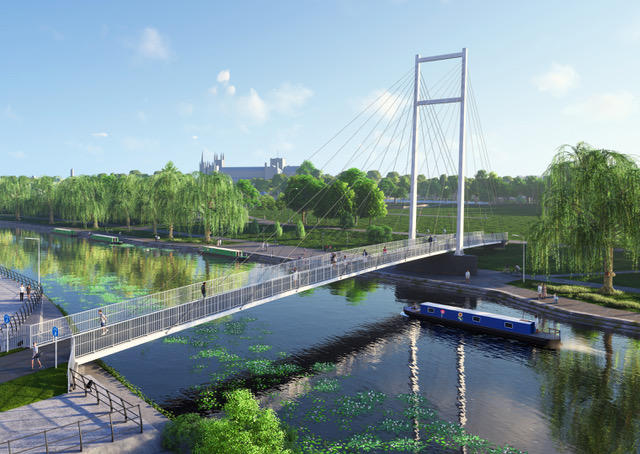
Following the adoption of the transport plan, Peterborough City Council and the CPCA began developing schemes that aligned with its priorities. One of these was a new pedestrian bridge linking key areas across the River Nene.
Over time, work focused on:
- Identifying the most beneficial location
- Connecting the bridge to existing walking and cycling routes
- Linking regeneration areas with the city centre and surrounding communities
The project developed into a direct, traffic-free crossing supporting everyday journeys, not just leisure use.
Funding the bridge
Cygnet Bridge is now fully funded, drawing on principles set out in the Local Transport Plan. These include Combined Authority investment in walking and cycling infrastructure, contributions linked to regeneration and development, and capital funding aimed at improving health, accessibility, and connectivity.
Crucially, the bridge has not been delivered at the expense of other services but through planned, long-term investment in infrastructure.
CPCA funding process
Initial funding in 2022 saw the CPCA approve a core contribution to the bridge project, estimated at £6.3 million. This included around £3.4 million from CPCA, with the remainder from Peterborough City Council and £2 million from the UK Government’s Towns Fund.
As the project progressed, design modifications and higher-than-expected sewer diversion costs increased the total estimated cost to £8.3 million. Peterborough City Council submitted a formal Change Request in late 2024.
The CPCA’s Funding Committee reviewed it on 13 January 2025, considering the full business case alongside other projects. The committee unanimously recommended approval of the additional £2 million to the full CPCA Board.
The Board approved the increase on 22 January 2025. The decision was described by some councillors as relatively uncontroversial, with funding released under the Single Assurance Framework conditions, including monitoring, milestones, and value-for-money checks.
Why it’s called Cygnet Bridge
As the project moved from concept to delivery, it was given a name reflecting both its location and purpose. “Cygnet Bridge” references the River Nene and its wildlife, symbolising something new emerging from careful planning.
The name was chosen through a public consultation in summer 2023, where residents could vote on five options. It became the preferred choice, receiving 28% of the vote.

Public support and consultation
The council undertook extensive public engagement. An online survey gathered 566 responses, and approximately 165 people participated in pop-up events at the Nene Park Festival and outside the Town Hall.
Stakeholder meetings included cabinet members, ward councillors, the Peterborough Civic Society, the Peterborough Cycle Forum, and the Disability Access Group.
Feedback from the public included:
- 79% supported the bridge
- 55% said the bridge would encourage them to walk or cycle more
- 85% supported new bins, 86% supported new benches
- 62% supported a potential art project
Construction timeline
Sewer diversion works began in September 2025. The main construction work is scheduled to begin in 2026, delayed from an original estimated completion of November 2024 due to design modifications and adverse weather. Planning approval was granted in December 2024.
The council said it was committed to ensuring the bridge was “both cost-effective and sustainable” in the long term.
What the bridge will achieve
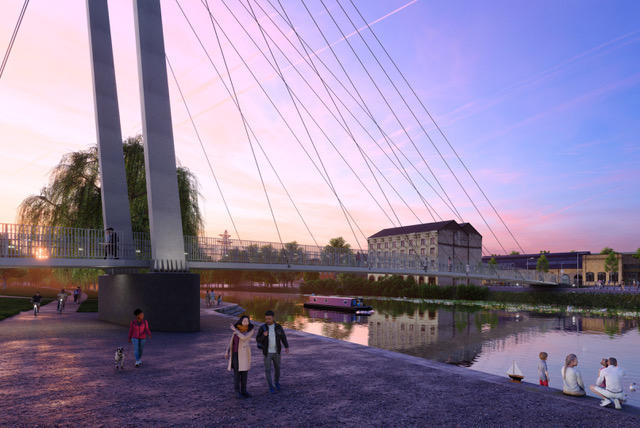
According to a council press release, Cygnet Bridge will provide a sustainable travel connection across the River Nene between the Embankment, Fletton Quays, and the city centre.
It will offer pedestrians and cyclists an alternative route away from the busy main road and create a link from the south of the city to the new university campus.
Project objectives include:
- Creating a new pedestrian crossing
- Improving pedestrian journey times between Fletton Quays and the Embankment
- Improving sustainable travel links
- Enhancing the riverfront and landscaping
- Protecting and improving biodiversity
- Assisting in creating a walkable, liveable city
- Reducing pressure on city centre traffic routes
Cost and funding
The total estimated cost of the bridge is £8.3 million, with funding coming from:
- £2 million from the Government’s Towns Fund, ring-fenced for the project
- £5.4 million from the Cambridgeshire & Peterborough Combined Authority
- The remainder from Peterborough City Council’s redevelopment budget
Prior to construction, approximately £1.2 million had already been spent on detailed design, structural checks, and professional fees.
Views from the city
During consultation, some residents raised questions about the need for the bridge and its value for money. However, council members emphasised the long-term benefits.
The late Nick Thulbourn, cabinet member for growth and regeneration, said: “We understand that people may not realise the full benefit of a bridge now, but they will once this area of the city develops further.
“The bridge is a vitally important piece of infrastructure.”
Peterborough City Council hoped the bridge would help create a “walkable, liveable city” and reduce pressure on city centre traffic routes, while linking people directly to the Goods Shed, a former railway building planned for redevelopment.