


Elisabeth Sennitt Clough, a former Fenland district councillor, has intensified her scrutiny of the £18.67 million Manor Leisure Centre redevelopment in Whittlesey, raising fresh concerns about consultation, governance, and design safety.
In a detailed update to her Stage 2 complaint, Sennitt Clough emphasises that key decisions on the pool and changing facilities appear to have been made at officer level before public consultation, contrary to guidance from Sport England and Swim England.
“Broadly, what I have gleaned thus far is that the design was developed and progressed at officer level,” she said.
“Layouts were agreed and taken forward before public consultation, despite Sport England/Swim England stating that public consultation had to shape the design. Records do not show elected members shaping or passing comment on early options.
“Questions need to be asked as to why the relevant elected members did not get involved in the early stages and follow government protocol.”

Consultation process and Sport England guidance under scrutiny
Sennitt Clough’s latest comments delve into specifics of the consultation process. She highlights that the Sport England/Swim England review requires demonstrable evidence that public consultation informed the chosen changing facilities design.
“No clear evidence has been provided showing how consultation feedback shaped the design,” she said. “Internal correspondence framed consultation as ‘not asking for a shopping list,’ which seems inconsistent with the requirement to demonstrate that consultation informed design decisions.”
Council documents acknowledge that female user feedback was not separately analysed during the October 2025 consultation—a gap that Sennitt Clough argues undermines the evidential basis for the current design.
Safeguarding, privacy, and design safety concerns
A key strand of Sennitt Clough’s complaint relates to safeguarding and user safety. An independent design review highlighted potential risks, noting that certain elements “could aid potential safeguarding issues” and “offer the opportunity for anti-social behaviour.”
She also flagged privacy concerns, citing internal emails that describe cubicles providing “modesty for a single person,” while some areas were proposed without anti-peep features. The review observed that users may need to “negotiate the changing village” to reach the pool, increasing movement through shared spaces with implications for supervision and privacy.

Evidence gaps remain, with Swim England repeatedly requesting calculations, capacity justification, and compliance evidence. Sennitt Clough says these gaps suggest that “key aspects of the scheme were not fully evidenced at the time of the review.”
Additional operational risks were identified, including decisions around asbestos surveys, structural cracking in the pool, telecom mast party wall issues, and the pool not meeting regulation length requirements.
Governance and decision-making oversight
Sennitt Clough has raised questions about the absence of elected member involvement in early design stages. She specifically points to Councillor Steve Count, the portfolio holder, questioning why oversight did not follow statutory and best-practice protocols.
“Had the right expertise and stakeholders been engaged from the outset, many of these issues could likely have been identified and addressed much earlier,” she said.

The former councillor also continues to press the council on equality considerations. She argues that the lack of a completed Equality Impact Assessment (EIA) before key design decisions undermines statutory obligations under the Equality Act 2010.
“Equality considerations should inform the evolution of proposals, not follow them,” she said. “It remains unclear whether Cabinet will be asked to proceed without a completed equality analysis.”
Whittlesey Town Council defers approval over unresolved issues
The community-run Radio Fenland Newsroom reported on Tuesday that the Whittlesey Town Council Planning meeting turned contentious, with councillors ultimately deciding to defer approval of the Manor Leisure Centre redevelopment until further information could be obtained.
“The concern was that other consultees had voiced concerns about the application or had not responded, and WTC wished for the issues to be answered before giving their approval,” Radio Fenland reported. “Whittlesey Town Council is also a consultee.”
During the debate, Councillors Haq Nawaz and Barry Wainwright clashed over the layout of the proposed changing rooms. Cllr Nawaz cited a Facebook poll showing that residents preferred traditional changing facilities.
Cllr Wainwright questioned whether a Facebook poll was the best way of judging public opinion. The meeting chair, Cllr Alex Miscandlon, argued that similar mixed changing spaces in March, George Campbell, and Wisbech Hudson Centre had operated without reported issues.
Wainwright added that mixed changing areas, with cubicles for privacy, had been in use in the North West for 35 years. He stated that such layouts were “safe areas” and offered greater flexibility for staff to maintain cleanliness and for families and schools to manage children and pupils within one area rather than across two.
It was noted that Cllr Dee Laws, a non-voting member of the committee as the Fenland DC portfolio holder for planning, “will take back comments from the meeting asking also for transparency of the details from the public consultation.”
The development now faces further scrutiny as councillors and the community continue to debate the implications of mixed changing facilities versus traditional layouts.
Financial, planning, and Local Authority Implications
The redevelopment represents Fenland District Council’s most ambitious capital project, estimated at £18.67 million. Plans include:
- A modern entrance with café and social space
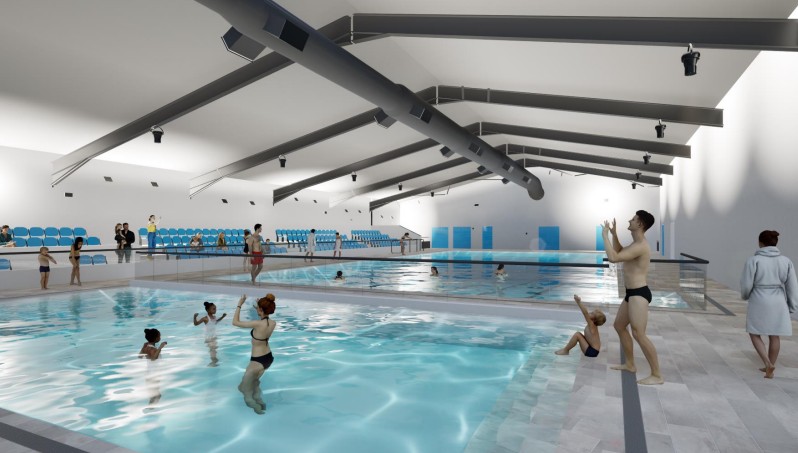
- Refurbished 25-metre six-lane pool and learner pool
- Expanded gym and two studios
- Flexible event space and community rooms
- Three covered padel courts and a new skate park
- Retained rifle range
- Improved accessibility and changing facilities
Despite the vision, local authorities have raised additional concerns. Whittlesey Town Council and other consultees have cited highways issues, water capacity concerns, and technical planning challenges. Sennitt Clough says these underline the importance of early-stage engagement and stakeholder oversight.
“Clarity is needed around governance and decision-making processes as the project progresses,” she said. “With a major financial commitment on the line and key decisions looming, the questions raised are central to the debate.”
Next Steps
The Stage 2 complaint is currently under review by a senior officer at Fenland District Council, with a response expected in late April. Meanwhile, detailed design work continues, with a final decision on whether to proceed with construction anticipated in June 2026. If approved, construction could start in August, targeting completion in late 2027.
“Residents deserve assurance that decisions are transparent, evidence-based, and meet statutory obligations,” said Sennitt Clough. “The council’s ambition is welcome, but process and oversight cannot be sidelined.”