

News for Peterborough and Cambridgeshire
  • CN Investigates
  • News
  • Crime
  • Your Views
No Result
View All Result
  • TRENDING:
  • Peterborough
  • Cambridge
  • Huntingdon
  • March
  • Wisbech
  • Ely
  • Fenland
  • Whittlesey
  • St Ives
Friday, April 17, 2026
News for Peterborough and Cambridgeshire
  • CN Investigates
  • News
  • Crime
  • Your Views
No Result
View All Result
News for Peterborough and Cambridgeshire
Support Us
No Result
View All Result
  • CN Investigates
  • News
  • Crime
  • Your Views
Home East Cambridgeshire District Council

East Cambridgeshire Council’s reservoir plan promises homes, jobs, and environmental gains

Local reservoirs: the key to Cambridgeshire’s water security and growth

John Elworthy by John Elworthy
9:45am, November 6 2025
in East Cambridgeshire District Council
0 0
East Cambridgeshire Council’s reservoir plan promises homes, jobs, and environmental gains Local reservoirs: the key to Cambridgeshire’s water security and growth East Cambridgeshire is at a crossroads. As climate change intensifies and the region’s population grows, the challenge of securing a reliable water supply has become urgent. A new report commissioned by the East Cambridgeshire District Council, prepared by the Eastern Powerhouse, lays out a bold vision: a network of local agricultural reservoirs, integrated with existing drainage infrastructure, to provide water resilience and unlock sustainable growth for the region. A pressing challenge Water security is not a distant concern for East Cambridgeshire. “It is a present and pressing issue that directly affects our ability to grow sustainably and provide the homes, jobs, and environment our communities deserve,” writes Cllr Anna Bailey, Leader of East Cambridgeshire District Council, in the report’s foreword. The proposal to create a local network of reservoirs is described as “a transformative opportunity” that could turn flood risk into a vital resource by capturing surplus winter flows and storing water for use during dry summer months. This approach, the report argues, would not only reduce pressure on drainage systems during heavy rainfall but also ensure a steady supply for homes, businesses, and agriculture when it is most needed. “It creates opportunities to restore wetlands, rewet peat soils, and enhance habitats for wildlife, making our water system part of a wider effort to recover biodiversity,” the report states. Climate risks and economic stakes East Cambridgeshire, situated within the South Level of the Fens—the UK’s largest coastal wetland—is highly exposed to climate-related risks. Rising sea levels, more frequent heavy rainfall, higher temperatures, and prolonged droughts threaten the region. The Fens have already experienced damaging events, including the tidal surge of 2013 and the drought of 2018. In 2022, a hot, dry summer caused water shortages. The report notes that “with adequate supply of water, the hotter weather will make the region’s agricultural sector more productive, representing an economic opportunity.” However, uncertainty over long-term water supply is creating a bottleneck for housing and inward investment, with major developments stalled due to concerns over water scarcity. The national and regional water challenge The East of England is one of the most water-stressed areas in the UK. Over-extraction from chalk aquifers and river systems threatens both ecosystems and long-term public supply. The region faces a projected water shortage of 800 million litres per day by 2050—about one third of current use. Yet, as the report points out, “the problem is not a lack of water,” but rather the capacity to store it and the ability of existing systems to respond dynamically to growth. Three major rivers—the Nene, the Ouse, and the Cam—deliver substantial excess water during the winter months. “Significant efforts have to be made in the region to pump excess water out into the North Sea, at great cost to Fenland farmers and taxpayers, only then to restrict water supplies for all users during the summer,” the report explains. The limits of centralised infrastructure While major infrastructure projects are in development, such as the proposed new reservoir near Chatteris, these solutions are years away. The Chatteris reservoir, led by Anglian Water, is projected to cost £2.2 billion and may not be completed before 2036. In the meantime, constrained supply is already halting or delaying new housing developments in Cambridgeshire. The report criticises the current regulatory system, which is “centred on 5 year price review periods,” for stifling innovation and leaving little room for place-based solutions. “Without reform, the system will continue to act as a brake on regional development,” it warns. A local solution: agricultural reservoirs The heart of the report’s proposal is a network of agricultural reservoirs, supported by local farmers and landowners, to supply incremental water demand until major infrastructure is delivered. There are already over 80 agricultural reservoirs across the district, with just seven farmers holding 5.4 million cubic metres of water in 24 mid-sized reservoirs—equivalent to 10% of the planned capacity at Chatteris. [ A recent technical study suggests that seven new mid-sized agricultural reservoirs could store 6 to 7 million cubic metres of water and could be built in under three years at a cost of £2–3 million each. The report highlights the cost-effectiveness: “A network of agricultural reservoirs would cost £4 to £5 per cubic metre of water compared with £40 per cubic metre from Chatteris.” Each reservoir, at 85% utilisation, could provide water for 7,000 people a year. Combined with demand reduction measures and interim supply from Grafham Water, this could meet projected housing growth over the next 15 years. Creating a local water market The development of agricultural reservoirs would also create a new “water market,” stimulating trade in water between farmers and into the local supply network. This would provide additional income for farmers and Internal Drainage Boards (IDBs), helping to stimulate the wider East Cambridgeshire economy. The report calls for public-private finance arrangements to share costs, risks, and rewards. A new water treatment works at Waterbeach is identified as a key component, with estimated costs ranging from £40 million to over £200 million, depending on scale. The report notes, “This is still a relatively small sum in the context of sustaining the continued growth of Greater Cambridge.” Reforming regulation and governance The report is critical of the current regulatory framework, which it describes as fragmented and siloed. It calls for “a system that is more accountable, transparent, and responsive to place-based needs,” including legislative changes to empower IDBs and give local authorities a stronger voice in water planning. A new Cambridgeshire and Peterborough Water and Growth Board is proposed to coordinate water infrastructure planning and delivery, bringing together water companies, regulators, local authorities, and community representatives. Conclusion: a call to action The report concludes that “the water crisis facing the East of England is not only a constraint but an opportunity.” By piloting new models of local water management, East Cambridgeshire can accelerate delivery and enhance sustainability. The council commits to supporting the development of agricultural reservoirs as part of its corporate strategy to address water scarcity and unlock growth. The recommendations are clear: continue to promote sustainable water management, support the development of agricultural reservoirs, work with regional partners to fund feasibility studies, and promote this model as a national pilot. For government, the report urges piloting water market reform, amending legislation to empower IDBs, and expanding the statutory role of local authorities in strategic water planning. As the report states, “East Cambridgeshire is well-positioned to lead by example, showing how local leadership, when empowered, can drive sustainable transformation.” All information and quotes sourced from the East Cambridgeshire District Council’s July 2025 report, “A network of local reservoirs: Providing water resilience and security to unlock growth in the region.” Here are the key benefits of agricultural reservoirs, as outlined in the East Cambridgeshire District Council report: • Fast delivery: Can be designed, approved, and built within three years. • Cost-effective: £4–£5 per cubic metre of water, compared to £40 per cubic metre for large-scale reservoirs. • Flexible and scalable: Can be expanded incrementally to match local housing and employment growth. • Environmental benefits: Supports peatland rewetting, wetland restoration, and biodiversity; reduces carbon emissions by using gravity-fed systems. • Improved drought and flood resilience: Stores surplus winter water for use in dry months and reduces flood risk by easing pressure on drainage systems. • Economic boost: Provides extra income for farmers and Internal Drainage Boards through water trading; supports local agricultural productivity. • Unlocks housing and development: Ensures a reliable water supply, enabling new homes and jobs. • Local control and innovation: Empowers local authorities, farmers, and landowners to manage water resources and encourages innovative, place-based solutions. ‘East Cambridgeshire is ready to lead. This report is our call to action, for government, regulators, and partners across the region to join us in turning a local solution into a national exemplar’ Cllr Anna Bailey Leader, East Cambridgeshire District Council

‘East Cambridgeshire is ready to lead. This report is our call to action, for government, regulators, and partners across the region to join us in turning a local solution into a national exemplar’ Cllr Anna Bailey Leader, East Cambridgeshire District Council

Share on FacebookShare on Twitter

East Cambridgeshire is at a crossroads. As climate change intensifies and the region’s population grows, the challenge of securing a reliable water supply has become urgent.

A new report commissioned by the East Cambridgeshire District Council, prepared by the Eastern Powerhouse, lays out a bold vision: a network of local agricultural reservoirs, integrated with existing drainage infrastructure, to provide water resilience and unlock sustainable growth for the region.

A pressing challenge

Water security is not a distant concern for East Cambridgeshire. “It is a present and pressing issue that directly affects our ability to grow sustainably and provide the homes, jobs, and environment our communities deserve,” writes Cllr Anna Bailey, Leader of East Cambridgeshire District Council, in the report’s foreword.

The proposal to create a local network of reservoirs is described as “a transformative opportunity” that could turn flood risk into a vital resource by capturing surplus winter flows and storing water for use during dry summer months.

Advertisements
DiscoverPeterborough

This approach, the report argues, would not only reduce pressure on drainage systems during heavy rainfall but also ensure a steady supply for homes, businesses, and agriculture when it is most needed.

“It creates opportunities to restore wetlands, rewet peat soils, and enhance habitats for wildlife, making our water system part of a wider effort to recover biodiversity,” the report states.

Climate risks and economic stakes

East Cambridgeshire, situated within the South Level of the Fens—the UK’s largest coastal wetland—is highly exposed to climate-related risks. Rising sea levels, more frequent heavy rainfall, higher temperatures, and prolonged droughts threaten the region. The Fens have already experienced damaging events, including the tidal surge of 2013 and the drought of 2018. In 2022, a hot, dry summer caused water shortages.

East Cambridgeshire Council’s reservoir plan promises homes, jobs, and environmental gains Local reservoirs: the key to Cambridgeshire’s water security and growth East Cambridgeshire is at a crossroads. As climate change intensifies and the region’s population grows, the challenge of securing a reliable water supply has become urgent. A new report commissioned by the East Cambridgeshire District Council, prepared by the Eastern Powerhouse, lays out a bold vision: a network of local agricultural reservoirs, integrated with existing drainage infrastructure, to provide water resilience and unlock sustainable growth for the region. A pressing challenge Water security is not a distant concern for East Cambridgeshire. “It is a present and pressing issue that directly affects our ability to grow sustainably and provide the homes, jobs, and environment our communities deserve,” writes Cllr Anna Bailey, Leader of East Cambridgeshire District Council, in the report’s foreword. The proposal to create a local network of reservoirs is described as “a transformative opportunity” that could turn flood risk into a vital resource by capturing surplus winter flows and storing water for use during dry summer months. This approach, the report argues, would not only reduce pressure on drainage systems during heavy rainfall but also ensure a steady supply for homes, businesses, and agriculture when it is most needed. “It creates opportunities to restore wetlands, rewet peat soils, and enhance habitats for wildlife, making our water system part of a wider effort to recover biodiversity,” the report states. Climate risks and economic stakes East Cambridgeshire, situated within the South Level of the Fens—the UK’s largest coastal wetland—is highly exposed to climate-related risks. Rising sea levels, more frequent heavy rainfall, higher temperatures, and prolonged droughts threaten the region. The Fens have already experienced damaging events, including the tidal surge of 2013 and the drought of 2018. In 2022, a hot, dry summer caused water shortages. The report notes that “with adequate supply of water, the hotter weather will make the region’s agricultural sector more productive, representing an economic opportunity.” However, uncertainty over long-term water supply is creating a bottleneck for housing and inward investment, with major developments stalled due to concerns over water scarcity. The national and regional water challenge The East of England is one of the most water-stressed areas in the UK. Over-extraction from chalk aquifers and river systems threatens both ecosystems and long-term public supply. The region faces a projected water shortage of 800 million litres per day by 2050—about one third of current use. Yet, as the report points out, “the problem is not a lack of water,” but rather the capacity to store it and the ability of existing systems to respond dynamically to growth. Three major rivers—the Nene, the Ouse, and the Cam—deliver substantial excess water during the winter months. “Significant efforts have to be made in the region to pump excess water out into the North Sea, at great cost to Fenland farmers and taxpayers, only then to restrict water supplies for all users during the summer,” the report explains. The limits of centralised infrastructure While major infrastructure projects are in development, such as the proposed new reservoir near Chatteris, these solutions are years away. The Chatteris reservoir, led by Anglian Water, is projected to cost £2.2 billion and may not be completed before 2036. In the meantime, constrained supply is already halting or delaying new housing developments in Cambridgeshire. The report criticises the current regulatory system, which is “centred on 5 year price review periods,” for stifling innovation and leaving little room for place-based solutions. “Without reform, the system will continue to act as a brake on regional development,” it warns. A local solution: agricultural reservoirs The heart of the report’s proposal is a network of agricultural reservoirs, supported by local farmers and landowners, to supply incremental water demand until major infrastructure is delivered. There are already over 80 agricultural reservoirs across the district, with just seven farmers holding 5.4 million cubic metres of water in 24 mid-sized reservoirs—equivalent to 10% of the planned capacity at Chatteris. [ A recent technical study suggests that seven new mid-sized agricultural reservoirs could store 6 to 7 million cubic metres of water and could be built in under three years at a cost of £2–3 million each. The report highlights the cost-effectiveness: “A network of agricultural reservoirs would cost £4 to £5 per cubic metre of water compared with £40 per cubic metre from Chatteris.” Each reservoir, at 85% utilisation, could provide water for 7,000 people a year. Combined with demand reduction measures and interim supply from Grafham Water, this could meet projected housing growth over the next 15 years. Creating a local water market The development of agricultural reservoirs would also create a new “water market,” stimulating trade in water between farmers and into the local supply network. This would provide additional income for farmers and Internal Drainage Boards (IDBs), helping to stimulate the wider East Cambridgeshire economy. The report calls for public-private finance arrangements to share costs, risks, and rewards. A new water treatment works at Waterbeach is identified as a key component, with estimated costs ranging from £40 million to over £200 million, depending on scale. The report notes, “This is still a relatively small sum in the context of sustaining the continued growth of Greater Cambridge.” Reforming regulation and governance The report is critical of the current regulatory framework, which it describes as fragmented and siloed. It calls for “a system that is more accountable, transparent, and responsive to place-based needs,” including legislative changes to empower IDBs and give local authorities a stronger voice in water planning. A new Cambridgeshire and Peterborough Water and Growth Board is proposed to coordinate water infrastructure planning and delivery, bringing together water companies, regulators, local authorities, and community representatives. Conclusion: a call to action The report concludes that “the water crisis facing the East of England is not only a constraint but an opportunity.” By piloting new models of local water management, East Cambridgeshire can accelerate delivery and enhance sustainability. The council commits to supporting the development of agricultural reservoirs as part of its corporate strategy to address water scarcity and unlock growth. The recommendations are clear: continue to promote sustainable water management, support the development of agricultural reservoirs, work with regional partners to fund feasibility studies, and promote this model as a national pilot. For government, the report urges piloting water market reform, amending legislation to empower IDBs, and expanding the statutory role of local authorities in strategic water planning. As the report states, “East Cambridgeshire is well-positioned to lead by example, showing how local leadership, when empowered, can drive sustainable transformation.” All information and quotes sourced from the East Cambridgeshire District Council’s July 2025 report, “A network of local reservoirs: Providing water resilience and security to unlock growth in the region.” Here are the key benefits of agricultural reservoirs, as outlined in the East Cambridgeshire District Council report: • Fast delivery: Can be designed, approved, and built within three years. • Cost-effective: £4–£5 per cubic metre of water, compared to £40 per cubic metre for large-scale reservoirs. • Flexible and scalable: Can be expanded incrementally to match local housing and employment growth. • Environmental benefits: Supports peatland rewetting, wetland restoration, and biodiversity; reduces carbon emissions by using gravity-fed systems. • Improved drought and flood resilience: Stores surplus winter water for use in dry months and reduces flood risk by easing pressure on drainage systems. • Economic boost: Provides extra income for farmers and Internal Drainage Boards through water trading; supports local agricultural productivity. • Unlocks housing and development: Ensures a reliable water supply, enabling new homes and jobs. • Local control and innovation: Empowers local authorities, farmers, and landowners to manage water resources and encourages innovative, place-based solutions. ‘East Cambridgeshire is ready to lead. This report is our call to action, for government, regulators, and partners across the region to join us in turning a local solution into a national exemplar’ Cllr Anna Bailey Leader, East Cambridgeshire District Council
‘East Cambridgeshire is ready to lead. This report is our call to action, for government, regulators, and partners across the region to join us in turning a local solution into a national exemplar’ Cllr Anna Bailey Leader, East Cambridgeshire District Council
The report notes that “with adequate supply of water, the hotter weather will make the region’s agricultural sector more productive, representing an economic opportunity.”

However, uncertainty over long-term water supply is creating a bottleneck for housing and inward investment, with major developments stalled due to concerns over water scarcity.

The national and regional water challenge

The East of England is one of the most water-stressed areas in the UK. Over-extraction from chalk aquifers and river systems threatens both ecosystems and long-term public supply. The region faces a projected water shortage of 800 million litres per day by 2050—about one third of current use.

Yet, as the report points out, “the problem is not a lack of water,” but rather the capacity to store it and the ability of existing systems to respond dynamically to growth.

Three major rivers—the Nene, the Ouse, and the Cam—deliver substantial excess water during the winter months.

“Significant efforts have to be made in the region to pump excess water out into the North Sea, at great cost to Fenland farmers and taxpayers, only then to restrict water supplies for all users during the summer,” the report explains.

The limits of centralised infrastructure

While major infrastructure projects are in development, such as the proposed new reservoir near Chatteris, these solutions are years away.

The Chatteris reservoir, led by Anglian Water, is projected to cost £2.2 billion and may not be completed before 2036. In the meantime, constrained supply is already halting or delaying new housing developments in Cambridgeshire.

The report criticises the current regulatory system, which is “centred on 5 year price review periods,” for stifling innovation and leaving little room for place-based solutions. “Without reform, the system will continue to act as a brake on regional development,” it warns.

Advertisement
Advertisements
canopyuk.com in-article

A local solution: agricultural reservoirs

The heart of the report’s proposal is a network of agricultural reservoirs, supported by local farmers and landowners, to supply incremental water demand until major infrastructure is delivered.

There are already over 80 agricultural reservoirs across the district, with just seven farmers holding 5.4 million cubic metres of water in 24 mid-sized reservoirs—equivalent to 10% of the planned capacity at Chatteris.
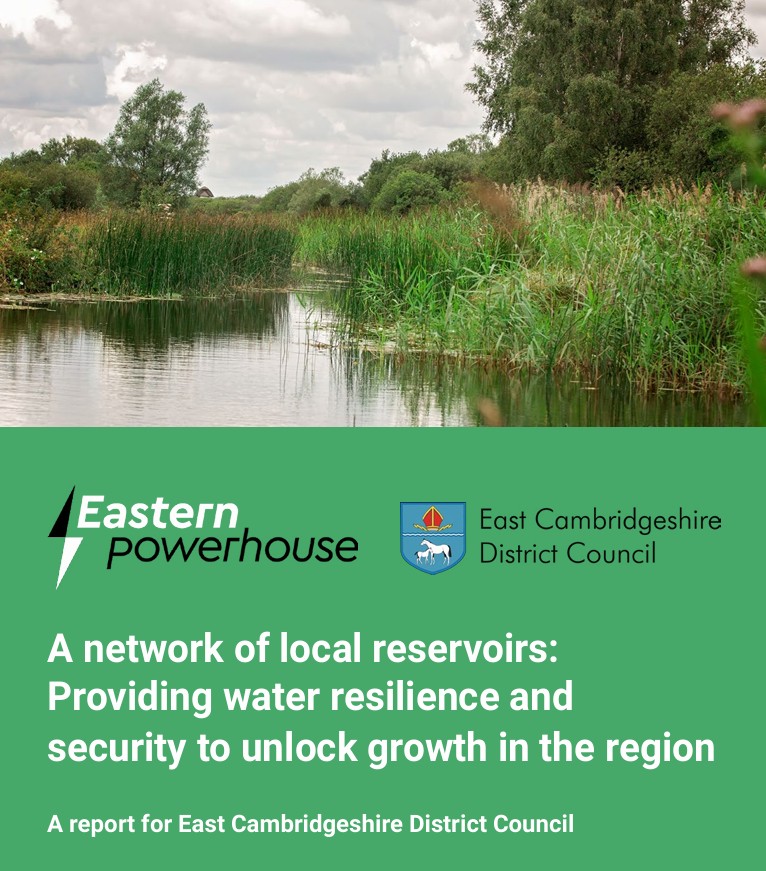
‘East Cambridgeshire is ready to lead. This report is our call to action, for government, regulators, and partners across the region to join us in turning a local solution into a national exemplar’ Cllr Anna Bailey Leader, East Cambridgeshire District Council

A recent technical study suggests that seven new mid-sized agricultural reservoirs could store 6 to 7 million cubic metres of water and could be built in under three years at a cost of £2–3 million each. The report highlights the cost-effectiveness: “A network of agricultural reservoirs would cost £4 to £5 per cubic metre of water compared with £40 per cubic metre from Chatteris.”

Each reservoir, at 85% utilisation, could provide water for 7,000 people a year. Combined with demand reduction measures and interim supply from Grafham Water, this could meet projected housing growth over the next 15 years.

Creating a local water market

The development of agricultural reservoirs would also create a new “water market,” stimulating trade in water between farmers and into the local supply network. This would provide additional income for farmers and Internal Drainage Boards (IDBs), helping to stimulate the wider East Cambridgeshire economy. The report calls for public-private finance arrangements to share costs, risks, and rewards.

A new water treatment works at Waterbeach is identified as a key component, with estimated costs ranging from £40 million to over £200 million, depending on scale. The report notes, “This is still a relatively small sum in the context of sustaining the continued growth of Greater Cambridge.”

Reforming regulation and governance

The report is critical of the current regulatory framework, which it describes as fragmented and siloed. It calls for “a system that is more accountable, transparent, and responsive to place-based needs,” including legislative changes to empower IDBs and give local authorities a stronger voice in water planning.

A new Cambridgeshire and Peterborough Water and Growth Board is proposed to coordinate water infrastructure planning and delivery, bringing together water companies, regulators, local authorities, and community representatives.

Conclusion: a call to action

The report concludes that “the water crisis facing the East of England is not only a constraint but an opportunity.”

By piloting new models of local water management, East Cambridgeshire can accelerate delivery and enhance sustainability. The council commits to supporting the development of agricultural reservoirs as part of its corporate strategy to address water scarcity and unlock growth.

The recommendations are clear: continue to promote sustainable water management, support the development of agricultural reservoirs, work with regional partners to fund feasibility studies, and promote this model as a national pilot.

For government, the report urges piloting water market reform, amending legislation to empower IDBs, and expanding the statutory role of local authorities in strategic water planning.

As the report states, “East Cambridgeshire is well-positioned to lead by example, showing how local leadership, when empowered, can drive sustainable transformation.”

All information and quotes sourced from the East Cambridgeshire District Council’s July 2025 report, “A network of local reservoirs: Providing water resilience and security to unlock growth in the region.”

Here are the key benefits of agricultural reservoirs, as outlined in the East Cambridgeshire District Council report:

  • Fast delivery: Can be designed, approved, and built within three years.
  • Cost-effective: £4–£5 per cubic metre of water, compared to £40 per cubic metre for large-scale reservoirs.
  • Flexible and scalable: Can be expanded incrementally to match local housing and employment growth.
  • Environmental benefits: Supports peatland rewetting, wetland restoration, and biodiversity; reduces carbon emissions by using gravity-fed systems.
  • Improved drought and flood resilience: Stores surplus winter water for use in dry months and reduces flood risk by easing pressure on drainage systems.
  • Economic boost: Provides extra income for farmers and Internal Drainage Boards through water trading; supports local agricultural productivity.
  • Unlocks housing and development: Ensures a reliable water supply, enabling new homes and jobs.
  • Local control and innovation: Empowers local authorities, farmers, and landowners to manage water resources and encourages innovative, place-based solutions.


Tags: Cllr Anna BaileyEast Cambs CouncilEastern PowerhouseHomepageLocal reservoirs
ShareTweetSend
Next Post
RSPCA Inspector Dean Astillberry who investigated the case said after the hearing: “As an RSPCA Inspector with 30 years experience it is clear to me that these dogs were living in circumstances that were likely to cause them suffering

Cruelty uncovered: Ramsey couple jailed after six starving pets found in filthy home

Animal Rising has released multiple images from their campaign at MBR Acres, Wyton, Cambridgeshire. Animal Rising describes itself as a social movement to create a new relationship “with all beings and give us a chance for a safe ecological future”

Cambridgeshire trial to spotlight MBR Acres beagle rescue

Help us by Donating

Latest News

News

UPDATE: Two Teenagers Charged with Murder of 16‑Year‑Old Baye Bireme Fall

April 15, 2026
Four people arrested following murder of a 16-year-old boy in Peterborough,
Orton Centre / Riseholme, Peterborough
Monday 13 April 2026. 
Picture by Terry Harris.
News

UPDATE: Two Arrested on Suspicion of Murder After Fatal Stabbing of 16‑Year‑Old in Peterborough

April 14, 2026
Police cordon in place near the Orton Centre in Peterborough following the fatal stabbing of a 16-year-old boy. Photos by Terry Harris.
Crime

Teen, 16, stabbed to death in Peterborough as four arrested in murder probe

April 13, 2026
• Paul Bristow says £1.5m is ready for a free parking trial across Peterborough and surrounding towns
Cambridgeshire and Peterborough Combined Authority

‘NOT GOOD ENOUGH!’ Bristow slams council in parking showdown

April 13, 2026
David Newton was sentenced to life in prison for the savage murder of a frail elderly widow 13 years ago. DNA found on Una Crown’s fingernails was crucial and new testing techniques gave the vital breakthrough police needed to charge Newton with her murder. Above: David Newton
Crime

The cold case murder that would not stay buried

April 11, 2026
Peter Reeve (bottom left) and Ryan Coogan (top left) leading Reform UK’s campaign across Cambridgeshire ahead of the May 7 local elections.
News

Reform UK sends political heavyweights into Cambridgeshire election battle

April 11, 2026
"The stolen van with the road roller inside – both recovered by Peterborough police after a Welland patrol."
Crime

Peterborough police recover stolen van and road roller in Welland patrol

April 9, 2026
Van packed with recovered stolen goods after a Cambridgeshire Police raid linked to the Brampton Hut Services theft
Crime

Cambridgeshire EV charger theft: £7,000 haul recovered in Essex raid

April 9, 2026
  • Trending
  • Comments
  • Latest
Police cordon in place near the Orton Centre in Peterborough following the fatal stabbing of a 16-year-old boy. Photos by Terry Harris.

Teen, 16, stabbed to death in Peterborough as four arrested in murder probe

April 13, 2026
David Newton was sentenced to life in prison for the savage murder of a frail elderly widow 13 years ago. DNA found on Una Crown’s fingernails was crucial and new testing techniques gave the vital breakthrough police needed to charge Newton with her murder. Above: David Newton

The cold case murder that would not stay buried

April 11, 2026

UPDATE: Two Teenagers Charged with Murder of 16‑Year‑Old Baye Bireme Fall

April 15, 2026
Peter Reeve (bottom left) and Ryan Coogan (top left) leading Reform UK’s campaign across Cambridgeshire ahead of the May 7 local elections.

Reform UK sends political heavyweights into Cambridgeshire election battle

April 11, 2026

UPDATE: Two Teenagers Charged with Murder of 16‑Year‑Old Baye Bireme Fall

0
Four people arrested following murder of a 16-year-old boy in Peterborough,
Orton Centre / Riseholme, Peterborough
Monday 13 April 2026. 
Picture by Terry Harris.

UPDATE: Two Arrested on Suspicion of Murder After Fatal Stabbing of 16‑Year‑Old in Peterborough

0
Police cordon in place near the Orton Centre in Peterborough following the fatal stabbing of a 16-year-old boy. Photos by Terry Harris.

Teen, 16, stabbed to death in Peterborough as four arrested in murder probe

0
• Paul Bristow says £1.5m is ready for a free parking trial across Peterborough and surrounding towns

‘NOT GOOD ENOUGH!’ Bristow slams council in parking showdown

0

UPDATE: Two Teenagers Charged with Murder of 16‑Year‑Old Baye Bireme Fall

April 15, 2026
Four people arrested following murder of a 16-year-old boy in Peterborough,
Orton Centre / Riseholme, Peterborough
Monday 13 April 2026. 
Picture by Terry Harris.

UPDATE: Two Arrested on Suspicion of Murder After Fatal Stabbing of 16‑Year‑Old in Peterborough

April 14, 2026
Police cordon in place near the Orton Centre in Peterborough following the fatal stabbing of a 16-year-old boy. Photos by Terry Harris.

Teen, 16, stabbed to death in Peterborough as four arrested in murder probe

April 13, 2026
• Paul Bristow says £1.5m is ready for a free parking trial across Peterborough and surrounding towns

‘NOT GOOD ENOUGH!’ Bristow slams council in parking showdown

April 13, 2026

Follow us on Twitter

More News

Priory Golf Centre has issued a statement after a seven-year-old boy died following an incident in a pond in Cambridgeshire. Police say the death is not suspicious. IMAGE: Google
News

Priory Golf Centre statement after tragic death of seven-year-old boy in Cambridgeshire

April 9, 2026
Key to explaining a proposed design layout: 1: Community Hub 2: Space for aftercare support 3: Garage for two critical carer cars 4: Hangar for two helicopters 5: Crew facilities 6: Training facilities CREDIT: Fabric First Architects
News

East Anglian Air Ambulance granted planning permission for new Cambridgeshire base

April 8, 2026
The cast of Spitfire Girls at Cambridge Arts Theatre portraying WWII women pilots.
News

REVIEW: Spitfire Girls at Cambridge Arts Theatre: ambitious tribute to WWII women pilots falls short

April 8, 2026
Young cannabis plants in the vegetative stage, short and bushy with bright green leaves and no visible buds. Estimated plants: 40–60 PHOTO: Cambridgeshire Police
Crime

CANNABIS SHOCK! New homeowner in Manea opens front door to MASSIVE drugs farm worth up to £70,000

April 8, 2026
Thousands of Cambridgeshire children are facing years long waits for autism diagnoses as NHS leaders admit demand has outpaced local services. The issue was discussed by the Cambridgeshire County Council health scrutiny committee
Cambridgeshire County Council

Thousands of Cambridgeshire children left waiting for autism diagnosis as NHS admits system under strain

April 8, 2026
RSPCA confirms shocking photo of 250 poodle-type dogs rescue was real, not AI. Radcliffe Animal Centre details rehabilitation of Eva and Teddy, urging adopters to help.
News

RSPCA confirms shocking photo of 250 poodle-type dogs rescue was real, not AI

April 7, 2026
  • News
  • Local Council
  • CN Investigates
  • Things To Do
  • About
  • Privacy Policy
  • Contact Us

© COPYRIGHT - UNIT 2 FENGATE TRADEPARK PETERBOROUGH PE15XB

Welcome Back!

Login to your account below

Forgotten Password?

Retrieve your password

Please enter your username or email address to reset your password.

Log In
We use cookies on our website to give you the most relevant experience by remembering your preferences and repeat visits. By clicking “Accept All”, you consent to the use of ALL the cookies. However, you may visit "Cookie Settings" to provide a controlled consent.
Cookie SettingsAccept All
Manage consent

Privacy Overview

This website uses cookies to improve your experience while you navigate through the website. Out of these, the cookies that are categorized as necessary are stored on your browser as they are essential for the working of basic functionalities of the website. We also use third-party cookies that help us analyze and understand how you use this website. These cookies will be stored in your browser only with your consent. You also have the option to opt-out of these cookies. But opting out of some of these cookies may affect your browsing experience.
Necessary
Always Enabled
Necessary cookies are absolutely essential for the website to function properly. These cookies ensure basic functionalities and security features of the website, anonymously.
CookieDurationDescription
cookielawinfo-checkbox-analytics11 monthsThis cookie is set by GDPR Cookie Consent plugin. The cookie is used to store the user consent for the cookies in the category "Analytics".
cookielawinfo-checkbox-functional11 monthsThe cookie is set by GDPR cookie consent to record the user consent for the cookies in the category "Functional".
cookielawinfo-checkbox-necessary11 monthsThis cookie is set by GDPR Cookie Consent plugin. The cookies is used to store the user consent for the cookies in the category "Necessary".
cookielawinfo-checkbox-others11 monthsThis cookie is set by GDPR Cookie Consent plugin. The cookie is used to store the user consent for the cookies in the category "Other.
cookielawinfo-checkbox-performance11 monthsThis cookie is set by GDPR Cookie Consent plugin. The cookie is used to store the user consent for the cookies in the category "Performance".
viewed_cookie_policy11 monthsThe cookie is set by the GDPR Cookie Consent plugin and is used to store whether or not user has consented to the use of cookies. It does not store any personal data.
Functional
Functional cookies help to perform certain functionalities like sharing the content of the website on social media platforms, collect feedbacks, and other third-party features.
Performance
Performance cookies are used to understand and analyze the key performance indexes of the website which helps in delivering a better user experience for the visitors.
Analytics
Analytical cookies are used to understand how visitors interact with the website. These cookies help provide information on metrics the number of visitors, bounce rate, traffic source, etc.
Advertisement
Advertisement cookies are used to provide visitors with relevant ads and marketing campaigns. These cookies track visitors across websites and collect information to provide customized ads.
Others
Other uncategorized cookies are those that are being analyzed and have not been classified into a category as yet.
SAVE & ACCEPT

Add New Playlist

No Result
View All Result
  • 360 Examples
  • About
  • Advertise with us
  • ARTICLE FOOTER NOT FOR PUBLICATION
  • Basket
  • Beer Festival VR 360
  • Buy Adspace
  • Cambridgeshire
  • Cancel donation
  • Cathedral Example 360
  • Cathedral Plan
  • Checkout
  • Checkout
  • Civic Dash
  • Complaints
  • Contact Us
  • Cookie Policy
  • cookie-policy
  • crm
  • Elementor #420
  • Hide Ads for Premium Members
  • Home
    • CambsNews Live
  • Latest News
  • Media Consent Form
  • media-consent-form
  • Memorial Garden Example
  • My Account
  • My account
  • Notices
  • Notices Form
  • Privacy Policy
  • PU test
  • Sample Page
  • Sample Page
  • Shop
  • SiteMap
  • Submit Your News
  • Subscribe CN Premium
  • Support our work.
  • test2
  • Thank you for your donation
  • Upload your ads

© COPYRIGHT - UNIT 2 FENGATE TRADEPARK PETERBOROUGH PE15XB